PwC South Africa is positioning hybrid quantum-classical computing as a practical, near-term tool for South African businesses grappling with deepening economic and climate uncertainty, in a new analysis from the consultancy’s Tech Strategy and Architecture team.
In The Benefits of Quantum Forecasting, published this month, PwC argues that the mathematical principles underpinning quantum computing offer a useful framework for modelling complex, high-dimensional systems that are increasingly stretching the limits of classical computing.
The uncertainty context
The paper opens with a wider frame. The World Uncertainty Index, an IMF-backed measure of geopolitical and macroeconomic volatility, sits at its highest level since records began. For South African organisations, that translates into climate-related risks, energy and infrastructure constraints, fluctuating commodity prices, and growing pressure on financial services and insurers.
Uncertainty is no longer an occasional disruption; it is the context in which all major business decisions are now made. The organisations that will succeed are not those that try to eliminate uncertainty, but those that build stronger capabilities to understand it, quantify it, and act on it with confidence.
Nico Vlok, Tech Strategy and Architecture Leader, PwC South Africa
Where classical methods are running out of room
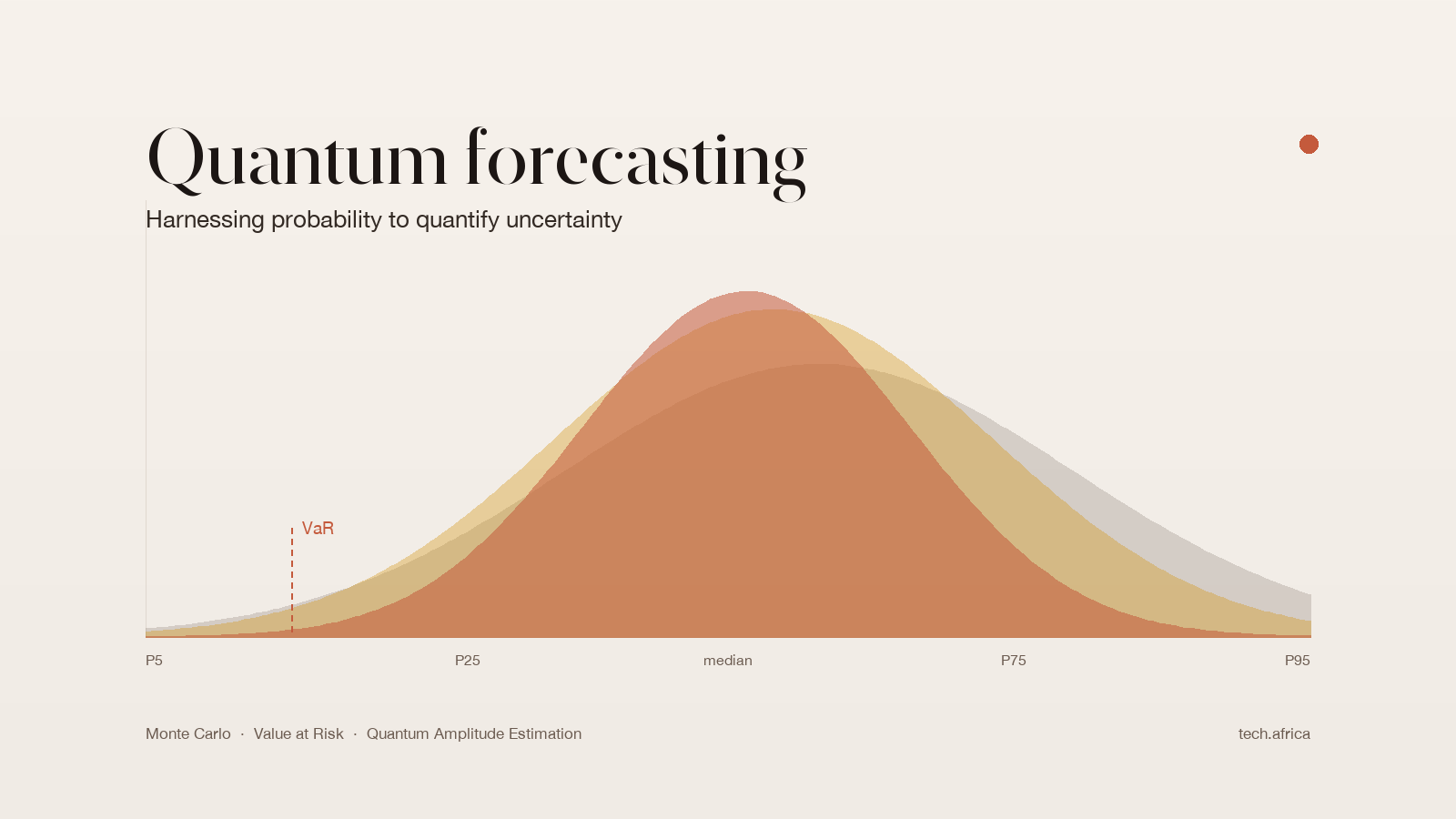
Industries such as banking, insurance, energy, mining, agriculture, and manufacturing rely heavily on probability modelling and scenario forecasting. Techniques like Monte Carlo simulations underpin routine risk metrics such as Value at Risk (VaR) and Conditional Value at Risk (CVaR). However, PwC argues that as economies and financial systems become more interconnected and more correlated, classical computing faces diminishing returns for rare but high-impact events, the “tails” of a distribution where the biggest losses sit.
The scale of that tail exposure is sizeable. Natural catastrophe events alone produced an estimated $318 billion in economic losses globally in 2024, with only 43 per cent insured. That leaves a $181 billion protection gap that re-insurers and sovereign risk pools are trying to close.
What hybrid quantum actually means
The paper is explicit that full-scale, fault-tolerant quantum computing is not here yet. Instead, PwC highlights hybrid quantum-classical approaches, in which a small part of a computation, typically the hardest to run on classical machines, is offloaded to a quantum processor, while data handling, governance, and validation remain on classical systems.
One concrete example is Quantum Amplitude Estimation (QAE), a technique that can, in theory, reduce the sampling effort required to achieve high statistical confidence in a rare-event probability estimate. For insurers and pension funds, that kind of efficiency could compress the cost of running VaR or CVaR models against increasingly complex climate and credit scenarios.
We are still in the early stages of quantum computing, and significant technical challenges remain. However, hybrid approaches allow organisations to start exploring where incremental value might emerge, without waiting for fully fault-tolerant quantum hardware.
Nico Vlok
A readiness question, not a hardware one
PwC frames quantum readiness as primarily a people, processes, and problem-selection question rather than an imminent hardware purchase. The firm’s position is that the window for careful early exploration, including quantum literacy programmes, controlled experimentation, and governance design, is now, well before the hardware is deployable at scale. Organisations that wait, the paper suggests, risk being caught flat-footed by competitors that have already done the groundwork by the time the technology is production-ready.




Leave a Reply