tech.africa is an independent technology news publication covering the African continent. We report on the companies, people and policies shaping Africa’s digital economy, from Lagos to Nairobi, Cairo to Cape Town.
Founded in 2004, the publication provides news, analysis and interviews for technology professionals, business leaders and the informed public.
Our story
tech.africa traces its roots to July 2004, when founder Oluniyi D. Ajao launched Mobile Africa, one of the earliest blogs dedicated to mobile technology on the continent. The publication has evolved through several iterations over two decades.
- 2004 Mobile Africa One of the earliest blogs dedicated to mobile technology on the continent.
- 2006 davidajao.com Broadened into general technology commentary across Africa.
- 2014 Techbaron Expanded into African tech startups and enterprise reporting.
- 2017 tech.africa Rebranded on the .africa TLD, consolidating two decades of African tech reporting under a single canonical domain.
In its current form, tech.africa brings together an archive of over 4,000 articles spanning two decades of African technology reporting.
What we cover
Our reporting spans the technologies driving Africa’s digital transformation:
- Artificial intelligence and machine learning
- Fintech and digital payments
- Cloud infrastructure and data centres
- E-commerce and digital commerce
- Connectivity: fibre, satellite and 5G
- Startups and venture capital
- Digital policy and regulation
- Cybersecurity
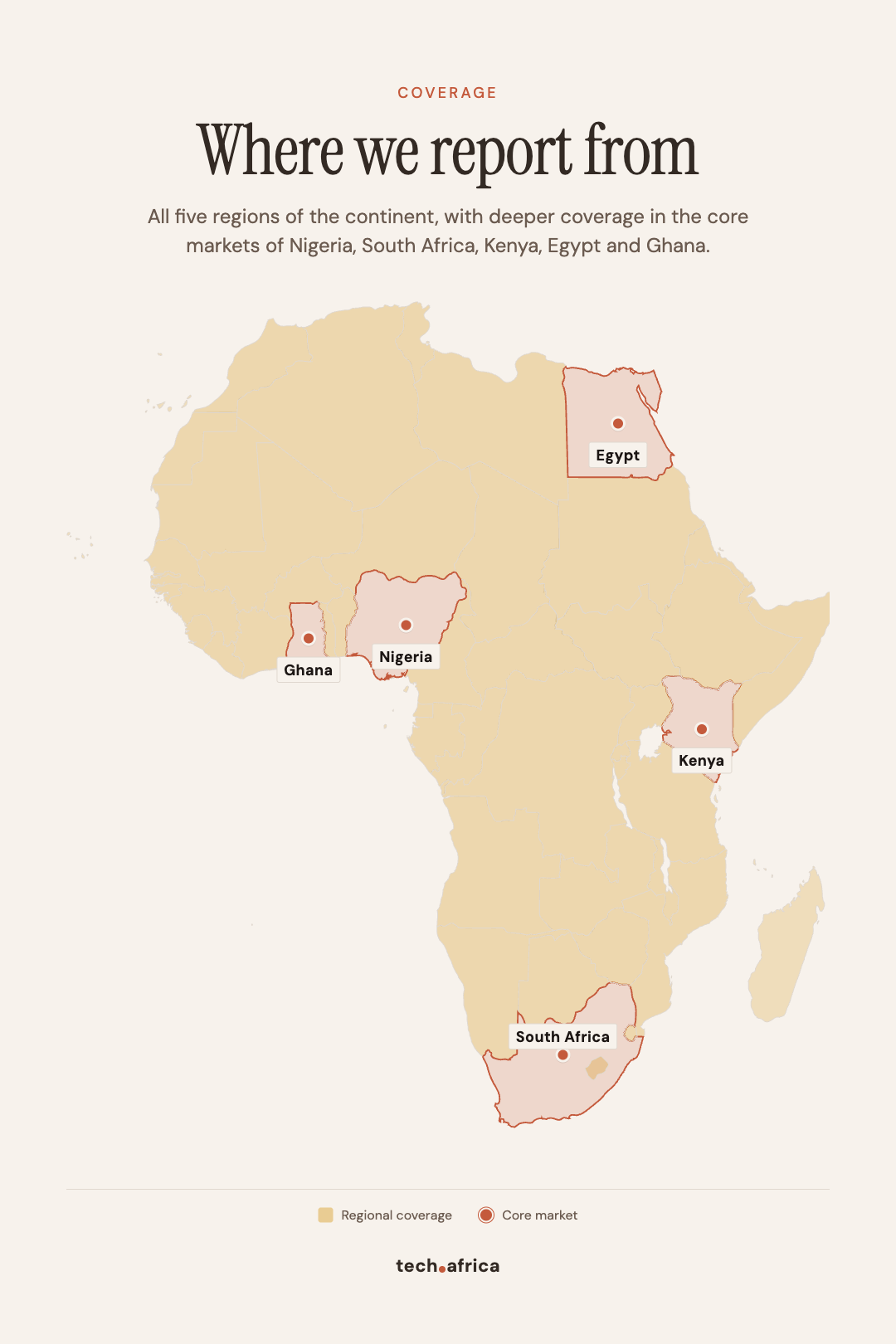
We cover all five regions of the continent (East, West, Central, North and Southern Africa), with deeper focus on the core markets of Nigeria, South Africa, Kenya, Egypt and Ghana.
Editorial team
Articles are published under the named author who reported and wrote them. Guest contributions and press release rewrites are credited separately in the byline.

Oluniyi D. Ajao
Editor and Founder
Internet entrepreneur with two decades of work in African internet infrastructure, including domain registration, ICANN policy, and web hosting. View bylines ›
Gbenga Ajao
Journalist
Mobile and web technology, telecommunications in Nigeria, and African startups. View bylines ›
For press release rewrites and newsroom aggregations, the byline reads “tech.africa Newsroom”.
Editorial policy
tech.africa maintains editorial independence from advertisers, sponsors and the companies we cover. The standards below govern every piece of content we publish.
Fact-checking and sourcing
- We verify the primary source of every story (official announcement, government gazette, reputable wire service) before publication.
- Surprising or unusual claims are cross-referenced against a second independent source.
- Numbers, dates, names, job titles and company names are always verified.
- Claims that cannot be independently verified are clearly attributed (“reportedly”, “according to”) rather than presented as fact.
Unnamed sources
- Unnamed sources are used only when the information cannot reasonably be obtained on the record and when the public interest in publishing outweighs the loss of attribution.
- The reason for granting anonymity is explained to the reader in the article (for example, “the source asked not to be named because they were not authorised to speak publicly”).
- Anonymous claims of fact are corroborated by at least one additional independent source where possible.
- An unnamed source is never used to make a personal attack on a named individual or organisation.
Corrections
- Factual errors are corrected transparently with a dated correction notice at the bottom of the article.
- Significant new developments are flagged with a dated “Updated” notice at the top.
- Articles are never deleted or unpublished to hide an error.
Press releases
- All press releases are fully rewritten by our editorial team; we do not publish press release language verbatim.
- Marketing language and PR puffery (“leading”, “world-class”) is removed unless inside a direct quote.
- Releases are placed in editorial context: why it matters, how it compares to competitors, what the broader trend is.
Disclosure and ethics
- Sponsored content is labelled “Sponsored” or “Paid Partnership” at the top of the article, before the lede.
- Affiliate links are disclosed with a standard notice.
- Where the publication has a commercial relationship with a company mentioned in an article, the relationship is disclosed.
- Competitors are referenced factually and neutrally. Comparative judgements are reserved for clearly labelled reviews and opinion pieces.
Diversity in our coverage
- Our reporting reflects the full geography of African technology, not only the dominant hubs. We actively seek stories from underreported markets in Central, North and the smaller economies of East, West and Southern Africa.
- We aim for a diverse range of named sources across gender, country of origin, and seniority. Where a story would otherwise rely entirely on one demographic of voices, we work to broaden the source list before publishing.
- We use African names, place names and currencies in their native conventions. We do not anglicise or rewrite African expertise into a foreign frame.
Reporting an error or sending feedback
If you believe an article contains a factual error, please reach us via our Contact page with the article URL and a description of the issue. We review every report. Confirmed errors are corrected within 24 hours of verification, with a dated correction notice attached to the article.
For coverage feedback, story tips and complaints, use the same Contact page. We aim to acknowledge substantive correspondence within five working days.
Work with us
- Sponsored articles: clearly labelled paid content, subject to editorial review.
- Press releases: submitted releases are rewritten by our newsroom before publication.
- Guest contributions: original articles from qualified contributors, subject to editorial vetting.
- Interviews: pitch yourself or nominate a company making an impact in African technology.
For all enquiries, visit our Contact page.
Connect with us
Follow tech.africa on social media for breaking news, analysis and updates from across the continent.
Disclaimer
tech.africa is not liable for any loss, injury, damage, or expense however caused, arising from the use of or reliance upon, in any manner, the information provided through this website and does not warrant the truth, accuracy or completeness of the information provided.
All trademarks recognised as properties of their respective owners.