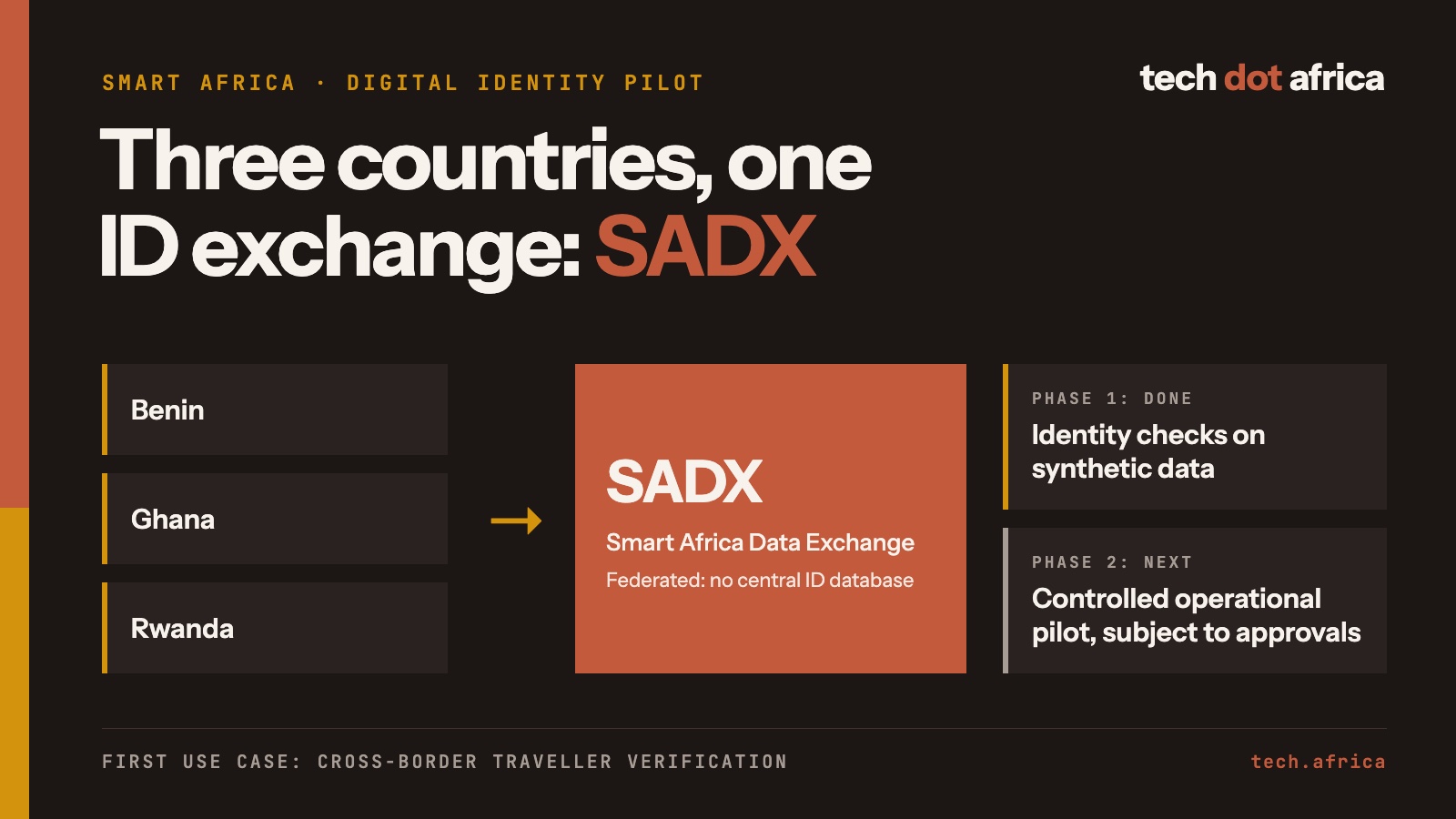
Benin, Ghana and Rwanda have connected their national identity systems to a shared data exchange and verified identities across borders, the first technical step in a Smart Africa pilot for cross-border digital ID.
Smart Africa, the alliance of African governments and private-sector partners, announced on 20 October 2026 in Kigali, Rwanda, that the countries had completed phase 1 of the pilot. The test used synthetic data in a controlled environment, not real citizens’ records.
A trust framework and an exchange
The pilot rests on 2 pieces. The Smart Africa Trust Alliance (SATA) provides the framework of trust, governance and cooperation between countries. The Smart Africa Data Exchange (SADX) is the infrastructure that lets their national systems exchange and verify information.
Smart Africa says the approach is federated: each country keeps its own identity database and control over its data, and nothing is centralised. “Interoperability does not require centralisation, and integration does not mean surrendering sovereignty,” said Lacina Koné, Director General and CEO of Smart Africa.
From airport e-gates to diplomas
The first use case is verifying travellers. Smart Africa gives the example of a traveller whose identity is checked against their home country’s official records at an automated airport e-gate.
It says the same system could later let a business prove it is legally registered in another country, a professional have a qualification recognised abroad, or a traveller verify vaccination records. Smart Africa links the work to the African Continental Free Trade Area (AfCFTA) and to its goal of a single digital market, and says it feeds into the African Union’s interoperability framework for digital ID.
What comes next
Phase 2 will prepare a controlled operational pilot for cross-border identity verification. Smart Africa said it depends on national approvals, security assessments and operational readiness, and gave no date. Results will go to the signatories of the SATA Declaration, who will be invited to consider joining later phases.
The declaration was signed by 19 countries with more than 335 million people: Benin, the Central African Republic, Chad, Comoros, the Republic of Congo, Côte d’Ivoire, Gabon, The Gambia, Ghana, Guinea, Madagascar, Rwanda, Senegal, South Sudan, Togo, Tunisia, Uganda, Zambia and Zimbabwe.
The pilot is backed by the countries’ national identification and ICT agencies and by partners including the African Development Bank, the European Union and the Norwegian Agency for Development Cooperation (Norad). Ascend Digital Solutions, which is delivering the technical foundation for SADX, said it looked forward to “the next phases of functional testing and wider rollout.”
Related coverage includes a partnership on African civil register digitisation and Ethiopia’s entry into the Pan-African Payment and Settlement System (PAPSS), another AfCFTA-linked cross-border system.


Leave a Reply