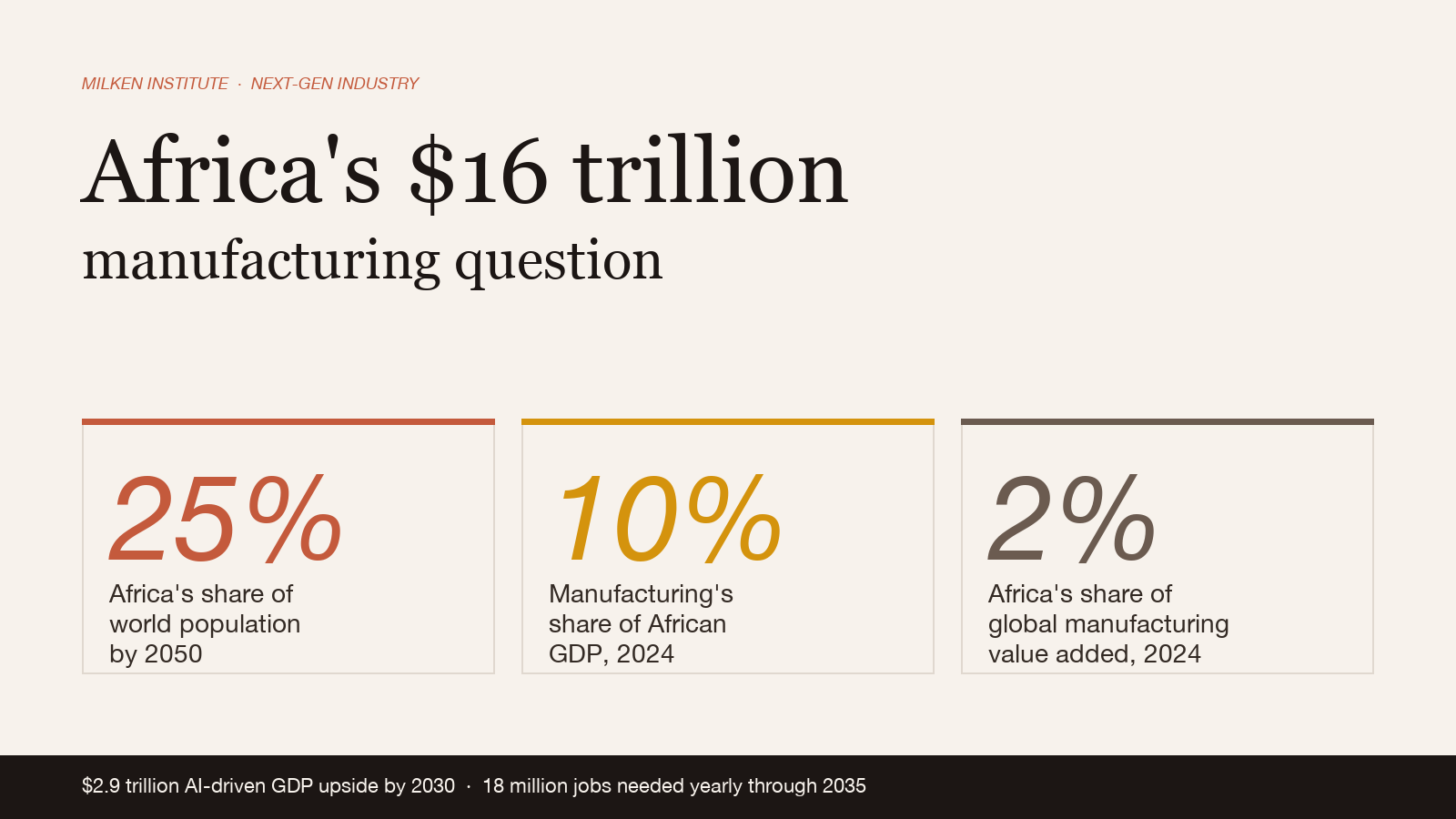
The Milken Institute on 24 April released Next-Gen Industry: A Prize in Scalable AI and Manufacturing Innovation, a report arguing that scaling artificial intelligence across African factories is now central to capturing the continent’s projected $16 trillion business and consumer spending market by 2050.
The report, authored by Terry Mulligan, Emily Musil and Adoma Addo, frames AI-driven manufacturing as the bridge between Africa’s demographic surge and its long-term prosperity. By 2050 the continent will hold roughly a quarter of the world’s population, yet manufacturing accounted for only 10 per cent of continental GDP and 2 per cent of global manufacturing value added in 2024. To absorb that growth, Africa must create about 18 million new jobs every year through 2035.
The productivity gap
African factories generate $7,608 of value added per worker on average, compared with $30,292 in East Asia and the Pacific in 2023. The Milken Institute pins much of the gap on unreliable infrastructure and waste. A 2025 World Bank survey cited in the report found sub-Saharan manufacturers experience about 14 hours of power outages each month, and firms lose roughly 5 per cent of annual sales to electrical interruptions alone.
African factory output climbed from about $170 billion in 2015 to nearly $235 billion in 2023, a 40 per cent increase, but the report argues that progress remains fragile. It points to Ethiopia’s textile parks, where exports collapsed from $175 million in 2021 to $120 million in 2023 after African Growth and Opportunity Act privileges were revoked, as evidence that policy shocks can quickly reshape sourcing decisions.
What AI can deliver now
The report sets out specific use cases where AI is already cutting costs in African operations. Predictive maintenance can reduce scheduled repairs by up to 12 per cent and overall maintenance costs by 30 per cent, the authors write, while computer-vision quality inspection achieves 99 per cent defect-detection accuracy at line speed against 85 per cent for manual checks. Light industry could see 8 per cent energy savings by 2035.
It cites Kenya’s Twiga Foods as a working example: AI-driven demand forecasting reduced typical postharvest losses from 30 per cent to 4 per cent by better matching supply with retailer orders. The Milken Institute frames such deployments as proof that low-cost, edge-based systems suited to local infrastructure realities can unlock durable productivity gains, complementing earlier coverage of how edge computing is shaping Industry 4.0 adoption.
Across Africa, AI is projected to lift cumulative GDP by roughly $2.9 trillion by 2030, against a global value PwC pegs at $15.7 trillion. African AI revenue today represents about 2.5 per cent of the global market, the report notes, citing AI4D Africa data.
$2 million prize seeks scalable solutions
The report accompanies the Milken-Motsepe Innovation Prize in AI and Manufacturing, the fourth competition in a partnership between the Milken Institute and the Motsepe Foundation. Total awards across the cycle are $2 million in non-dilutive capital. Ten semifinalists received $50,000 each in September 2025, with five finalists earning an additional $30,000 in December 2025. The grand prize of $1 million, a runner-up award of $250,000 and a $100,000 prize for the most advanced use of Fourth Industrial Revolution technology will be announced in May 2026.
Submissions are scored against four 25-point pillars: commercial viability, operational economics, technological integration and market scalability in Africa. Previous prize cycles covered AgriTech in 2023, Green Energy in 2024 and FinTech in 2025. The Milken Institute reports a 31-fold return on prize money in follow-on investments to date and an online community of more than 12,000 people across 136 countries.
Policy tailwinds align
The report flags converging policy support. The number of African nations with official AI or digital-industry strategies has risen from zero in 2018 to 17, with others in process. The African Continental Free Trade Area’s Digital Trade Protocol is establishing continent-wide standards for data flows, e-signatures and cybersecurity, while more than 220 special economic and industrial parks are now operating across 47 of Africa’s 54 countries.
The World Bank estimates that more than 230 million jobs in sub-Saharan Africa will require digital skills by 2030, many of them at intermediate levels involving data analytics and cybersecurity. Manufacturing currently accounts for roughly 13 per cent of Africa’s carbon footprint, largely from energy-inefficient equipment and diesel backup generators, the report adds, framing AI tools that cut waste and optimise energy use as also serving climate goals.
The full report is available on the Milken Institute website. The grand prize winner is due to be announced at the Milken Institute Global Conference, taking place 3-6 May 2026 in Los Angeles.




Leave a Reply