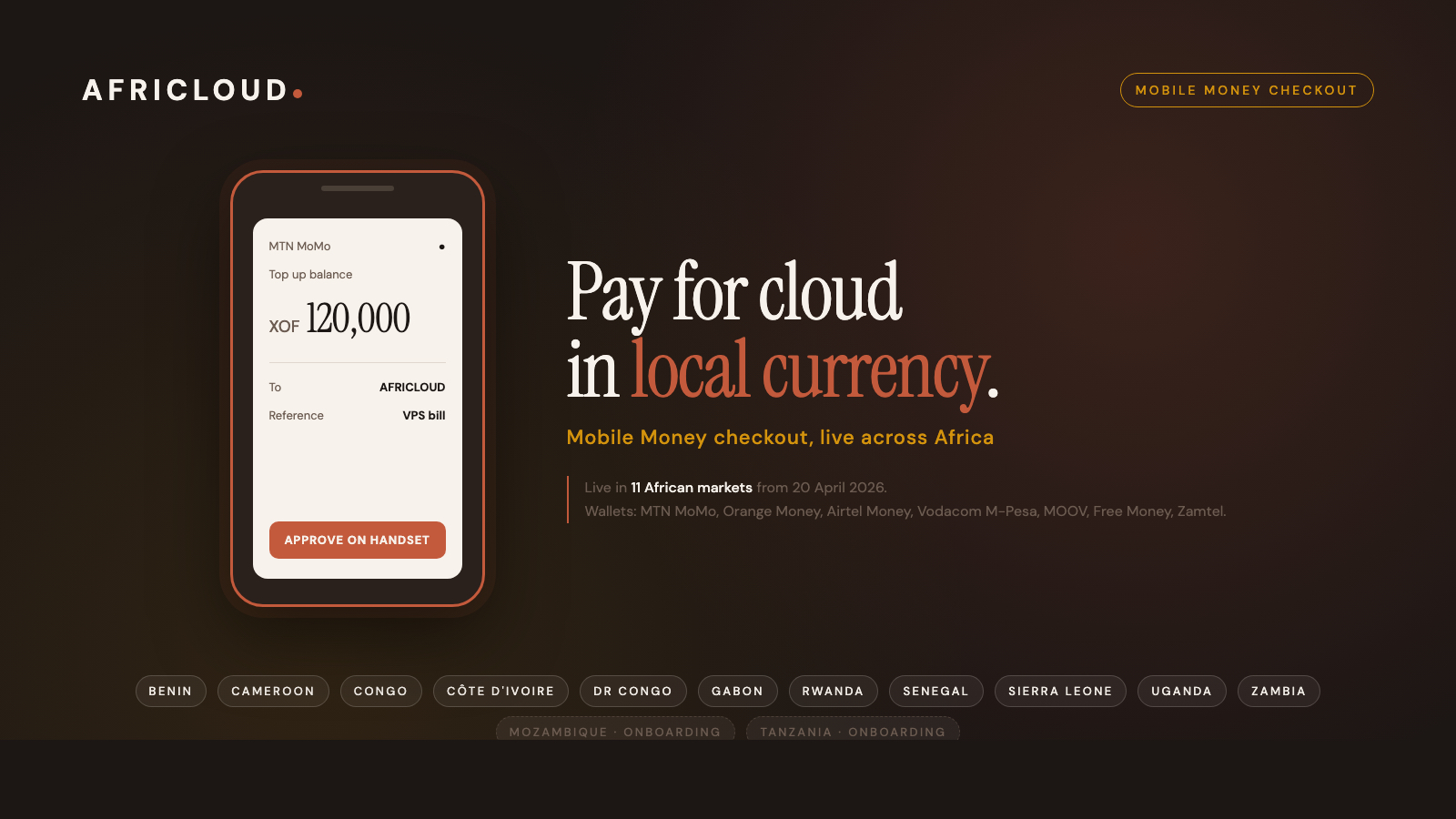
africloud.com”>AFRICLOUD, a cloud infrastructure company with data centres in Lisbon and Johannesburg, has activated mobile money checkout in 11 African markets, allowing customers to pay for cloud servers, storage, and networking services in local currency from a wallet on their phone. The capability went live on 20 April 2026 across Benin, Cameroon, the Republic of Congo, Côte d’Ivoire, the Democratic Republic of Congo, Gabon, Rwanda, Senegal, Sierra Leone, Uganda, and Zambia, with onboarding underway in Mozambique and Tanzania.
The change addresses a long-running friction in the African cloud market. Cloud infrastructure pricing has historically been quoted in dollars or euros and settled by international card. African buyers without a Visa or Mastercard with sufficient international limits, or facing foreign exchange controls on outbound recurring USD charges, have either turned to cryptocurrency or asked a colleague abroad to cover the bill.
A continent-sized rail
Mobile money is the dominant non-cash payment system across much of the continent. According to the GSMA’s State of the Industry Report on Mobile Money 2024, sub-Saharan Africa processed USD 1.1 trillion in mobile money transactions last year, equivalent to 65% of global mobile money value. 74% of all global mobile money activity by transaction count occurred on the continent, and roughly 40% of adults in the region now hold a mobile money account, a 13 percentage-point increase since 2021.
For cloud buyers, mobile money sits inside the customer’s local financial system. It bypasses FX controls, card limits, and bank refusals on recurring foreign-currency charges, which have slowed African business adoption of pay-as-you-go infrastructure. Cryptocurrency rails have served the same function for some buyers: a December 2025 analysis noted that crypto already represents a meaningful share of cloud orders settled out of Africa. Mobile money extends that payment-flexibility principle to customers without crypto exposure.
Where the rail is live
The country-by-country wallet inventory at launch:
| Country | Wallets accepted | Local currency |
|---|---|---|
| Benin | MOOV, MTN MoMo | XOF |
| Cameroon | MTN MoMo | XAF |
| Congo (Brazzaville) | Airtel Money, MTN MoMo | XAF |
| Côte d’Ivoire | MTN MoMo, Orange Money | XOF |
| DR Congo | Airtel Money, Orange Money, Vodacom M-Pesa | USD or CDF |
| Gabon | Airtel Money | XAF |
| Rwanda | Airtel Money, MTN MoMo | RWF |
| Senegal | Free Money, Orange Money | XOF |
| Sierra Leone | Orange Money | SLE |
| Uganda | Airtel Money, MTN MoMo | UGX |
| Zambia | MTN MoMo, Zamtel | ZMW |
| Mozambique (pending) | Vodacom M-Pesa | MZN |
| Tanzania (pending) | Airtel Money, Halotel, Tigo Pesa | TZS |
In the Democratic Republic of Congo, customers can choose to settle in US dollars or Congolese francs. In every other market, wallet payments are processed in local currency and converted at the day’s rate to the customer’s chosen billing currency on the AFRICLOUD account, which can be USD, EUR, GBP, ZAR, or NGN.
How a top-up works
The flow follows a sequence familiar to anyone who has paid a utility bill from a mobile wallet:
- The customer signs into the AFRICLOUD billing platform at my.africloud.com.
- They choose “Top up account” and select their country.
- They pick a wallet, for example, MTN MoMo, and enter the mobile money phone number associated with it.
- They approve the charge on their handset, typically via a USSD prompt or a push notification from the wallet app.
- Once funds clear, the balance is credited to the customer’s AFRICLOUD account in their chosen billing currency at the day’s exchange rate.
- The account balance can then be used to pay for any AFRICLOUD service: cloud servers, object storage, block storage, virtual private cloud, floating IPs, managed DNS, or dedicated servers.
The markets not yet covered
The launch covers 11 of Africa’s 54 countries, and the company has been explicit about which markets are excluded and why.
Nigeria, Ghana, Kenya, and South Africa are currently geo-restricted on the AFRICLOUD platform until July 2026 for unrelated contractual reasons. Mobile money rails in those markets are technically ready, particularly for Kenya’s M-Pesa and Ghana’s MTN MoMo, and would follow once the platform unblock takes effect.
Two markets, Burkina Faso and Malawi, are deferred. The mobile money providers in those countries require local entity registration that AFRICLOUD has not undertaken. In North Africa (Egypt, Morocco, Algeria, Tunisia, Libya) and in Ethiopia, the company does not currently offer a mobile money rail; customers there continue to use card or cryptocurrency.
AFRICLOUD’s payment mix
AFRICLOUD is a Wyoming-registered cloud infrastructure company with offices in Miami Beach, Florida. Its network runs as autonomous system AS209179, with two infrastructure sites. The Lisbon presence is located within MEO Altice’s Linda-a-Velha campus, which also houses DE-CIX Lisbon. The Johannesburg presence sits within Teraco’s Isando campus, overlooking NAPAfrica, the continent’s largest internet exchange. The Johannesburg site is hosted within a Teraco facility certified to ISO/IEC 27001, PCI DSS, ISAE 3402 Type 2, ISO 14001, and ISO 50001.
Mobile money joins an unusually wide range of payment options. AFRICLOUD already accepts cards through Stripe, PayPal, and more than 300 cryptocurrencies, including Bitcoin, Ethereum, USDT, Litecoin, and Monero. The company says roughly a quarter of completed orders in the trailing 180 days settle in cryptocurrency, an indicator of demand for non-card options that mobile money is expected to extend.
The mobile money rollout follows a platform expansion in March 2026 that added object storage, block storage, virtual private cloud, and managed DNS to the existing virtual server line.
A test for B2B payment localisation
Mobile money in cloud checkout sits within a small but growing category of business-to-business pricing localisation. Most international software and infrastructure providers continue to quote in USD or EUR and accept only cards. The few that have added local payment rails, typically through partnerships with regional payment service providers, have generally seen conversion rates lift in markets with structurally low card penetration.
For AFRICLOUD, the immediate test will play out in the lower-card-penetration countries on its launch list, particularly the CFA franc zone and Sierra Leone, where cryptocurrency adoption among small and medium enterprises is also lowest. Whether mobile money becomes a meaningful share of cloud sales or settles in as a convenience option for a minority of customers will be visible in subsequent quarterly figures.


Leave a Reply