EDITORIAL PROFILE · RELATED-PARTY DISCLOSURE
Cloud infrastructure operator that operates from data centres in Lisbon and Johannesburg, serving customers across Africa, South America and Europe with VPS, storage and networking. Tagline: “Own Your Cloud.”
AFRICLOUD is operated by the same ownership group as tech.africa. We cover AFRICLOUD with the same editorial standards we apply to other African cloud and infrastructure companies. This profile is provided for context.
About AFRICLOUD
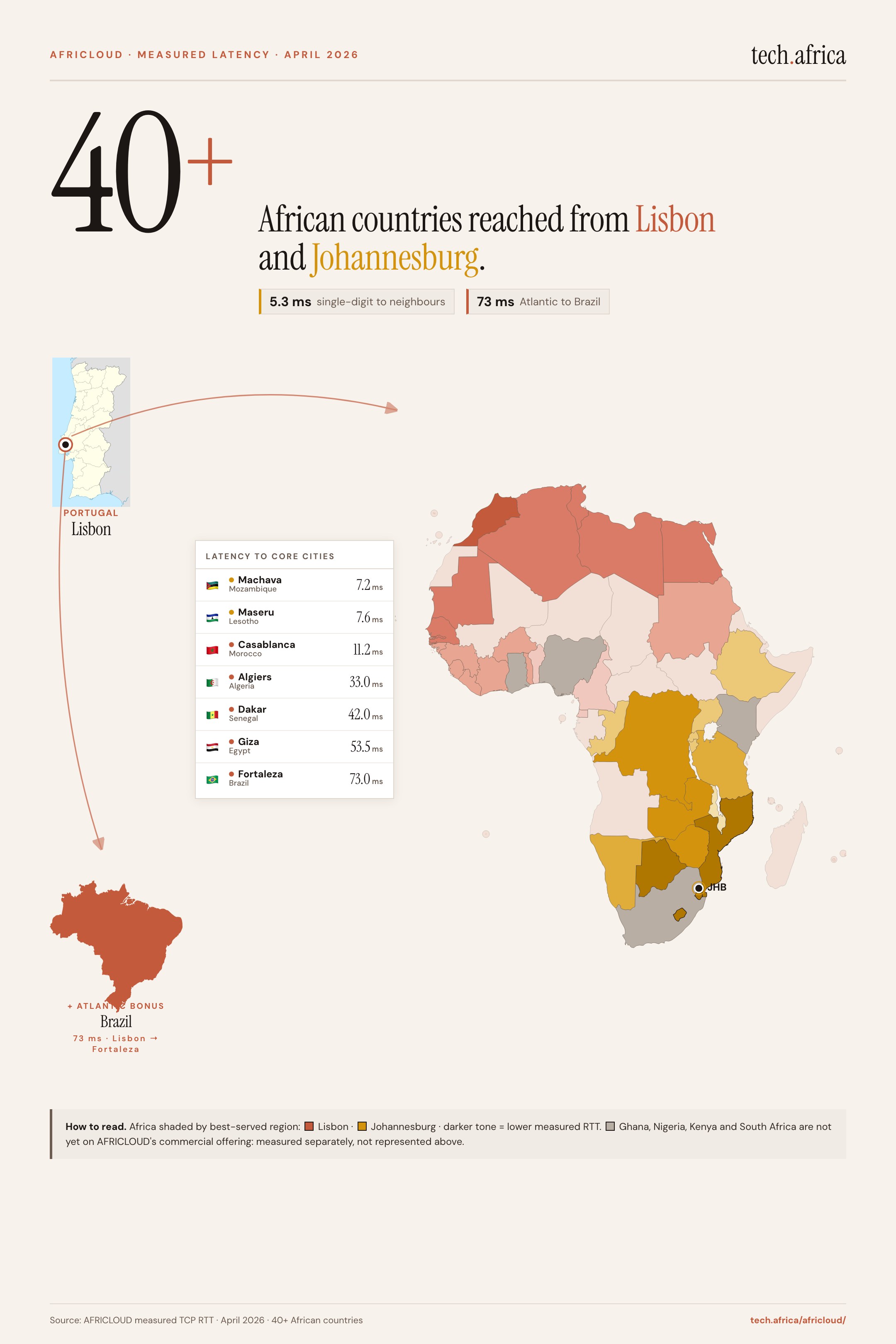
AFRICLOUD is a cloud infrastructure provider that operates from two data centres: Lisbon (Portugal) and Johannesburg (South Africa). Its primary product is virtual private server (VPS) hosting on NVMe storage with AMD EPYC compute, fronted by a 100 Gbps network and DDoS protection. The Lisbon facility serves Europe, North and West Africa, and South America via direct Atlantic routing; the Johannesburg facility covers Southern and East Africa with sub-10ms latency to neighbouring SADC markets.
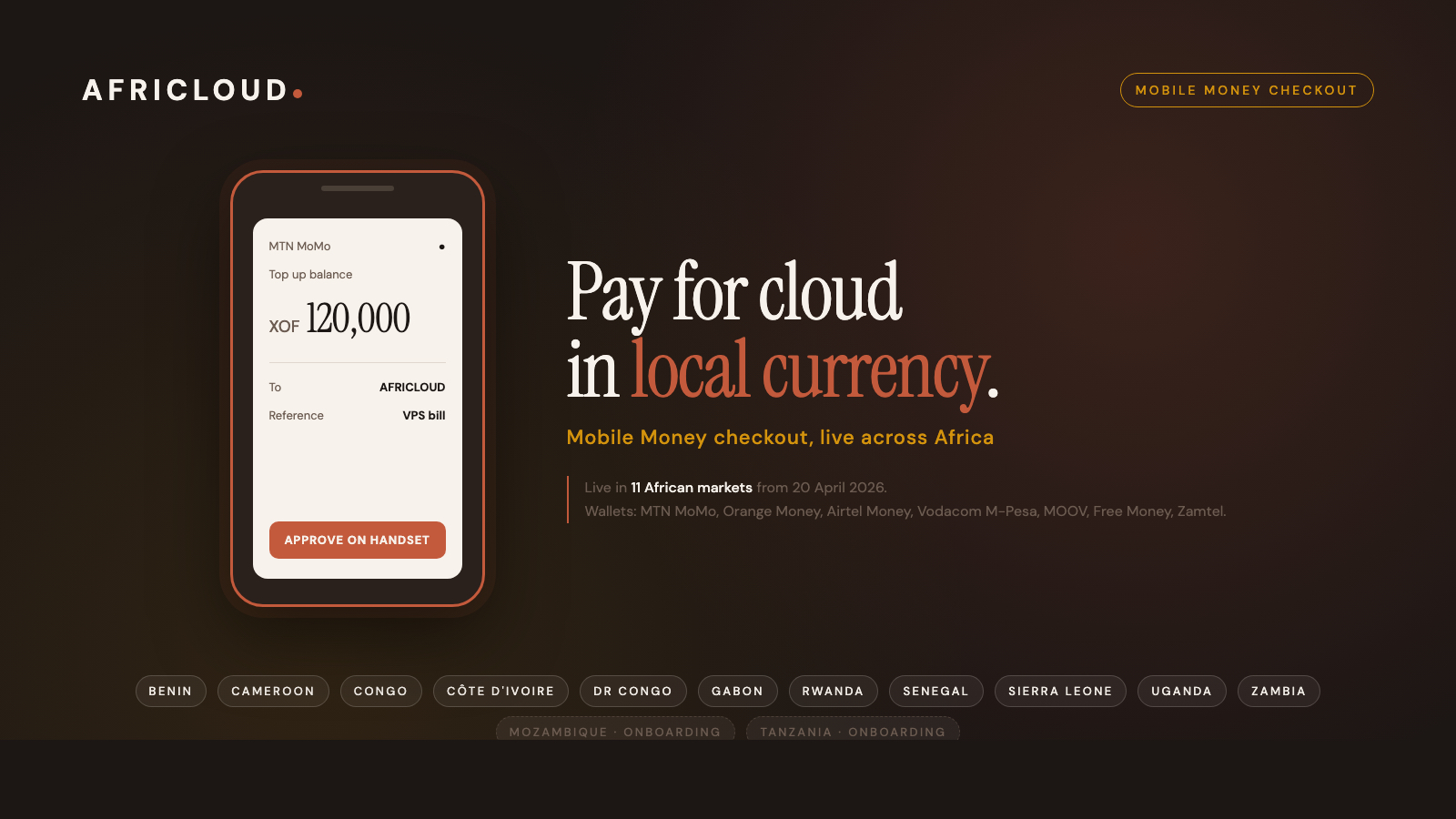
The company’s positioning argument is payment-method coverage. Beyond the conventional credit card and PayPal, AFRICLOUD accepts more than 300 cryptocurrencies (including Bitcoin, Ethereum, USDT and USDC), and supports mobile money in 11 African countries. Billing is available in five currencies: USD, EUR, GBP, NGN and ZAR. The combination is aimed at founders and SMBs in markets where foreign-currency card declines, forex spreads, or banking-relationship gaps make traditional cloud providers difficult to access.
The Johannesburg footprint launched ahead of the Lisbon presence; AFRICLOUD’s Lisbon presence went live in late 2025, adding the Atlantic routing path used by South American customers and serving as a low-latency edge for European-facing African businesses. AFRICLOUD’s product roadmap includes managed Kubernetes, object storage, and an expanded API. The customer base spans 39 countries across the three serviced continents.
Quick facts
| Founded | 2025 (current operating entity) |
|---|---|
| Data centres | Lisbon (Portugal) · Johannesburg (South Africa) |
| Primary products | Cloud VPS · Storage · Networking |
| Hardware | NVMe storage, AMD EPYC compute, 100 Gbps network |
| Payment methods | Credit/debit card · PayPal · 300+ cryptocurrencies · Mobile money (11 countries) |
| Billing currencies | USD · EUR · GBP · NGN · ZAR |
| Markets served | 39 countries across Africa, South America, Europe |
| Website | africloud.com |
Coverage on tech.africa All articles →



Latency map
On YouTube
 Cloud VPS Hosting Ethiopia: 70ms from Johannesburg12 Jun 2026
 VPS Cloud pour Madagascar : 28 ms depuis Johannesburg7 Jun 2026
 Cloud VPS for Mauritius: 39 ms from Johannesburg6 Jun 2026
 Cloud VPS Hosting Lesotho: 7.6ms from Johannesburg12 May 2026
 Cloud VPS Uganda: Pay in Shillings, Bitcoin, or Card8 May 2026
 Cloud VPS Hosting Tanzania: 44ms from Johannesburg8 May 2026
 Servidor Europeu para o Brasil: 73ms de Lisboa a Fortaleza | AFRICLOUD6 May 2026
 Buy a VPS with Bitcoin in 2 Minutes5 May 2026
 How to Buy a VPS with Crypto in 2 Minutes [Bitcoin]5 May 2026
 Pay for Cloud with Mobile Money in 11 Countries4 May 2026
 Cloud VPS Moçambique: 7.4ms desde Joanesburgo4 May 2026
 Cloud VPS Hosting Eswatini: 6.1ms from Johannesburg2 May 2026
Frequently asked
What is AFRICLOUD?
AFRICLOUD is a cloud infrastructure provider that operates virtual private servers (VPS), storage and networking from data centres in Lisbon (Portugal) and Johannesburg (South Africa), serving customers across 39 countries in Africa, South America and Europe.
Where are AFRICLOUD’s data centres located?
Two data-centre points of presence: Lisbon, Portugal (co-located in Digital Realty’s facility, live since late 2025) and Johannesburg, South Africa (the original AFRICLOUD presence). The Lisbon site uses direct Atlantic routing for South American customers and a 28ms path to London for European users; the Johannesburg site delivers sub-10ms latency to most SADC markets.
What payment methods does AFRICLOUD accept?
Conventional methods (credit and debit cards, PayPal) plus more than 300 cryptocurrencies, including Bitcoin, USDT, USDC and Ethereum. Mobile money is supported in 11 African countries. Billing is available in five currencies: USD, EUR, GBP, NGN and ZAR.
Which countries does AFRICLOUD serve?
39 countries across Africa, South America and Europe. African coverage is anchored in Southern and East Africa (via Johannesburg) and West and North Africa (via Lisbon). South American customers reach Lisbon over the Atlantic with measured latencies of 73ms to Fortaleza, 107ms to Sao Paulo and 120ms to Rio de Janeiro.
How does AFRICLOUD compare with hyperscalers like AWS, Azure or Google Cloud?
AFRICLOUD is significantly smaller than the hyperscalers and focuses on a different problem: payment-method accessibility for African and South American customers. The hyperscalers offer broader product portfolios and global region counts; AFRICLOUD offers crypto and mobile-money payment paths and local-currency billing that hyperscalers do not. tech.africa’s broader hyperscaler peering coverage is collected in the African peering series (forthcoming).
Where to find AFRICLOUD
- Website: africloud.com
- YouTube: @africloudhost
- LinkedIn: linkedin.com/company/africloud
- X (Twitter): @africloudhost
- Instagram: @africloud
- Facebook: facebook.com/africloudhost