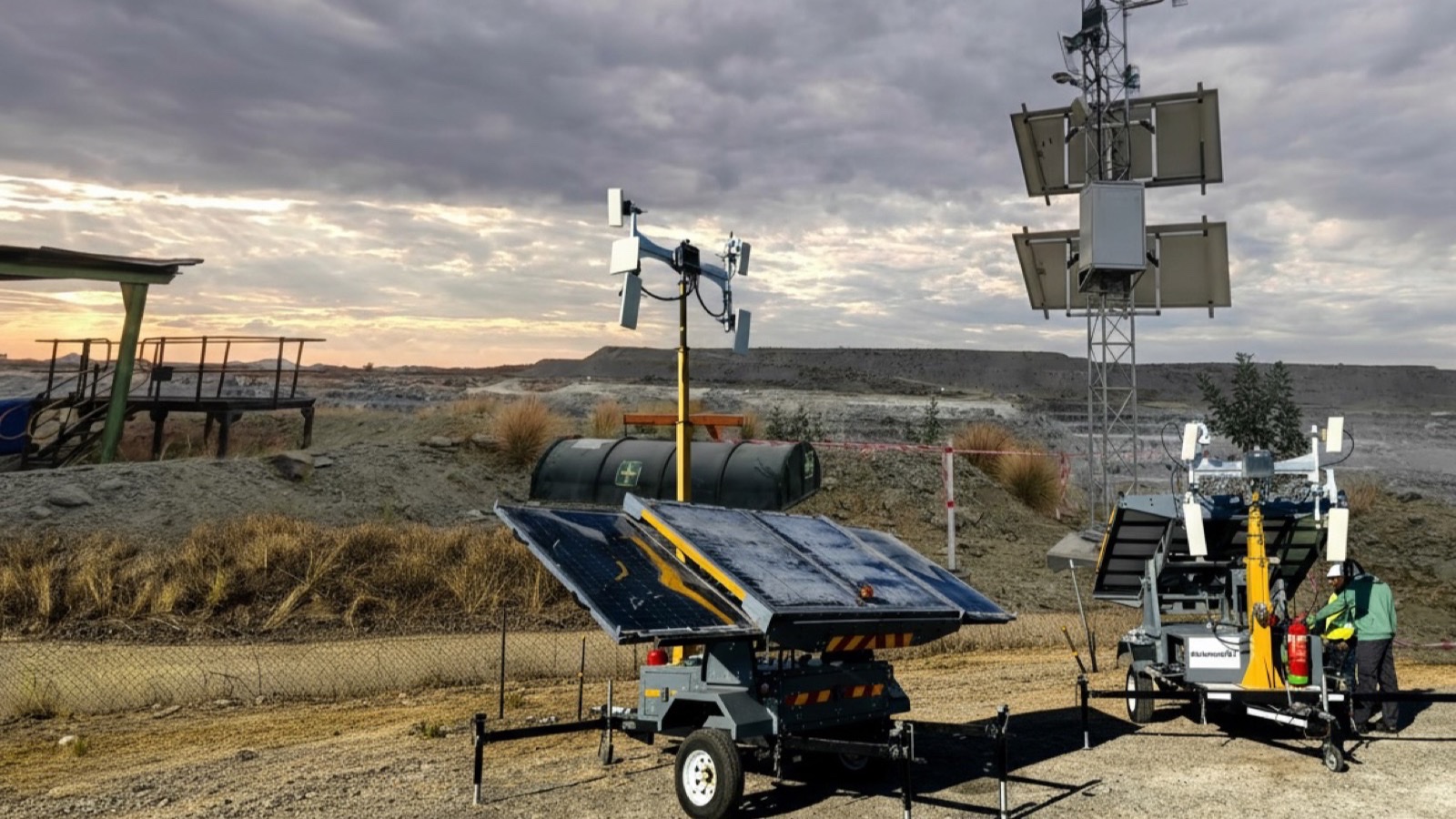
South African platinum and chrome producer Tharisa Minerals has deployed RADWIN’s FiberinMotion adaptive wireless network across its Rustenburg open-pit mine, marking the first African implementation of the technology.
The deployment, delivered with hybrid ICT systems integrator Datacentrix, replaces a legacy 3G coverage arrangement that relied on SIM cards in selected fleet vehicles. The new network is now serving the Tharisa Mine in the western limb of the Bushveld Complex, a region home to more than 70% of the world’s platinum and chrome resources.
A network that moves with the pit
Open-pit mining presents a connectivity problem that fixed networks struggle to solve: benches shift, haul roads move and line-of-sight conditions are continuously affected, creating dead spots. The Tharisa-Datacentrix deployment uses a hybrid architecture combining fixed high sites for point-to-multipoint and point-to-point connectivity with two ruggedised, trailer-mounted six-metre towers that act as nomadic high sites and move with the pit as it evolves.
“The simplest way to describe it is that the hotspots are always moving,” Paul Collins, chief information officer at Tharisa, said. “You don’t want to constantly rebuild your network infrastructure to accommodate this. It needs to adapt automatically as the operational environment evolves.”
An alternative to LTE and 5G
Tharisa evaluated private LTE and 5G alongside mesh networks before settling on the RADWIN solution. Collins said the cost did not justify the value for the mine’s use case: “We’re a low-cost producer, so we actively look for solutions that support this strategy.”
Gys Malan, solutions architect at Datacentrix, said the design brief was to deliver functionality similar to LTE and 5G “but without the associated cost and complexity”, and without the management overhead typical of traditional mesh networks. The total cost of ownership is also lower because the infrastructure can be managed end-to-end internally, Malan added.
What is now possible
After a phased proof-of-concept that tested roaming, handover and stability across excavators, dump trucks and light-duty vehicles, Tharisa moved to a permanent rollout that has been operational for roughly a year. The platform now carries telemetry, performance monitoring, video feeds from equipment such as excavators, and fleet-safety data that allows Tharisa to flag unsafe machine operation.
“What started as a challenge to achieve reliable connectivity has become a long-term proven platform strategy for us,” Collins said. “We now know that we’ve invested in something that is not only effective today, but reusable across the group and scalable for the future.”
The group is extending the same technology to Karo Platinum, its newer low-cost open-pit operation on the Great Dyke in Zimbabwe.


Leave a Reply