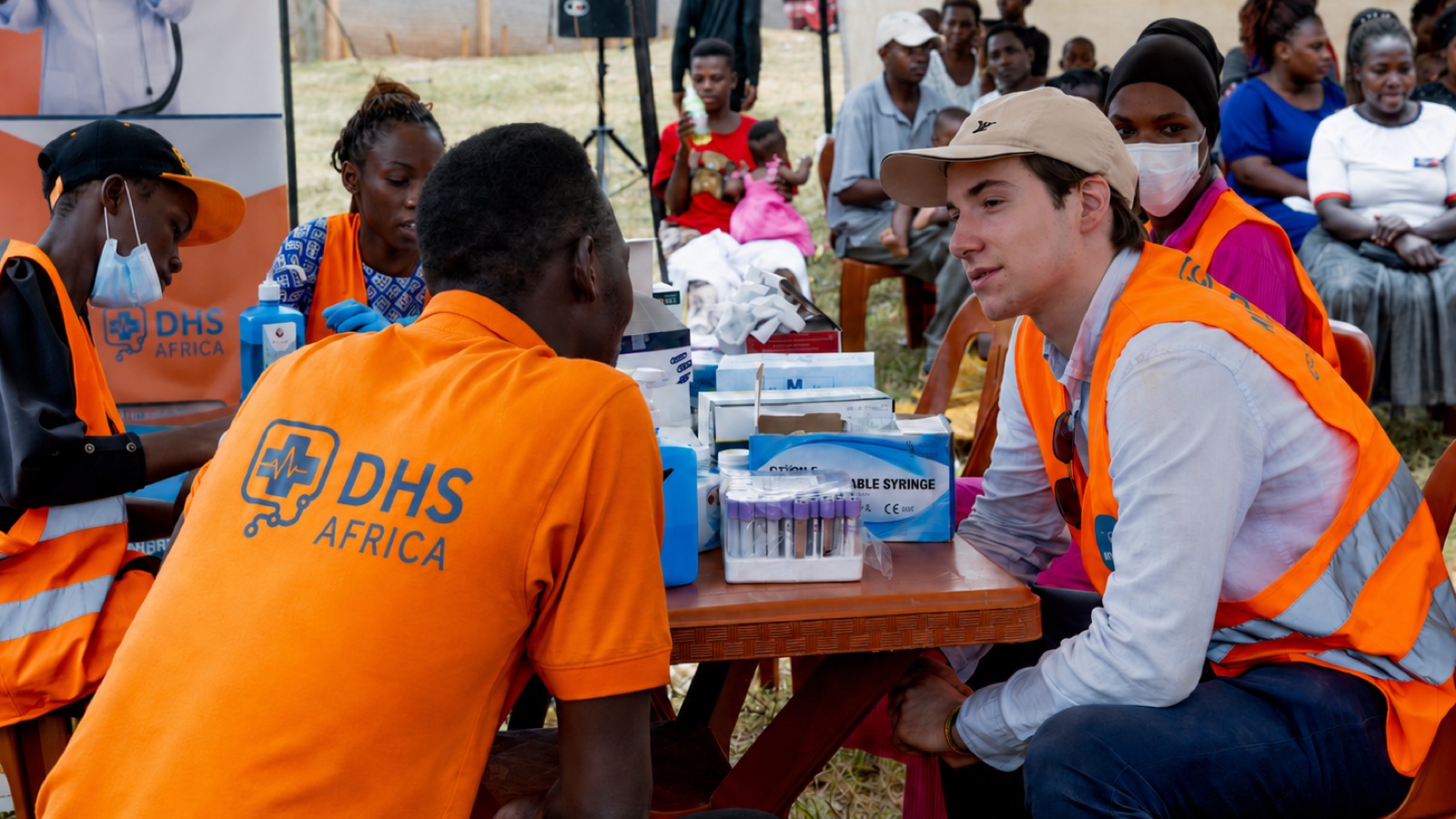
It is mid-morning on a Tuesday at an outpatient clinic in East Africa. Reception is working a queue that spans the desk and three screens. A patient sent a WhatsApp message ninety minutes ago, in mixed English and a local language, saying her son has had a fever and a cough for two days and asking whether she should bring him in today. Two USSD callback requests have come in from feature-phone users since nine. An SMS reply has just confirmed an appointment for tomorrow. A walk-in is filling out her first-visit details next to a sign written in Swahili.
A clinician opens the next case on her screen. The system has already prepared the intake from the mother’s message: symptoms, duration, the child’s age, the language she wrote in, a paediatric flag, a routine priority. The original message sits beside the structured version in the mother’s own words. A lab result from three months ago is loaded. She reads the brief in under a minute and decides to bring the child in this afternoon rather than book for Wednesday.
Over the past few years, the DHS Africa teams in Munich, Nairobi, and Kampala have built digital healthcare systems for hospitals and clinics across multiple African markets, and have watched the same scene play out site after site. The literature on African digital health tends to treat scenes like this as the difficult edge case for Western enterprise systems. They are closer to the case healthcare AI was meant to handle.
The catch-up story is out of date
For the last decade, digital health in African markets has been described as a catch-up story. The continent will eventually build the kind of enterprise software the United States and Europe already run, including Epic, Cerner, and the rest of the stack, and AI will then arrive as an upper layer added on top. Funders, ministries, and many providers themselves treat this sequence as the natural one.
The sequence is out of date. In Western markets, the systems treated as the destination here have become the problem AI is being deployed to solve. American doctors spend close to half their working hours on data entry, with another one to two hours of charting after they get home. A decade of research has tied that documentation load to clinician burnout at a population scale. AI work at large hospitals now mostly takes the form of expensive retrofits, fitting language models and copilots into software designed for a different decade’s assumptions.
It is not a destination worth aiming for.
Where the EMR fights AI
Modern AI in clinical software depends on a few things, and the Western EMR is poor at supplying any of them.
The mismatch starts with the unit of analysis. The EMR is built around the encounter: a scheduled visit, a fifteen-minute slot, a chart note filed at the end. AI is useful across longer arcs: an inbound message at week one, a callback at week two, a clinic visit at week three, a lab result at week four. The encounter view collapses the arc into separate entries, and most of the patient story disappears between them.
There is also the question of input. Language models handle free text well: what a patient wrote in their own words, in their own language. Western systems still operate on the assumption that the only input that counts is what a doctor typed into a form. Patients rarely behaved that way, and they behave that way even less now, with messaging in their pocket and a queue at the desk.
Then there is the doctor’s place in the workflow. AI can structure intake, draft summaries, flag patterns, suggest routing. The doctor reads, approves, overrides, decides. American medicine still expects her to also type the underlying note from scratch. Adding AI to that workflow tends to add another click rather than remove one, because the architecture pushes against the integration.
Those properties are not abstract. They determine whether AI in a clinic saves time or wastes more of it.
What is being built in African clinics looks different
Scenes like the one above are routine across the hospitals and clinics where DHS Africa has these systems running in production. The case is the visible unit of work, and it crosses channels constantly.
An episode often starts with a mother sending a WhatsApp message in mixed English and a local language. The system detects the language, extracts the symptoms and duration, scores priority, flags the case for paediatric routing, and surfaces it so the doctor has the file open before she reaches for it. The mother is given a callback or an appointment later that day. When she arrives, the walk-in registration pulls up the case already in progress. The doctor examines the child. The lab order goes in through the same record. Results return to the mother by SMS the next day. A follow-up reminder is scheduled.
None of this is exotic. It is what care looks like when patients reach a clinic through the channels they actually use, namely WhatsApp, USSD, SMS, phone, and the front desk, and when the software around them is built around that fact.
The same pattern shows up in other workflows. Community health workers in villages capturing field data on offline-first tablets that sync once the device has signal. Prescription refills handled through WhatsApp, with follow-up by phone and payment through mobile money on the same case. Different on the surface, identical in architecture.
In Kenya and Uganda, this is the default rather than the workaround. Mobile money handles a large share of clinic payments. Between them, WhatsApp and USSD reach most of the patient population a clinic will see in any given week. Systems that ignore those channels lose patients before the doctor ever sees them.
Where the two fit together
The work of maintaining continuity across a WhatsApp message, a callback, a walk-in, and a follow-up is what these clinics already do. The case is the unit on the ground, and so the case is the unit in the system. There is no extra layer to build before AI can think across encounters.
Intake comes in as text written by patients in their own words, in their own languages, on the phones they have. Reading that and turning it into a structured brief is the kind of work language models do well. It also happens to be the work that produces the biggest operational win: a free-text inbound message becomes a one-screen brief a doctor can read in under a minute.
The doctor reads and decides. The AI prepares the case before she opens it. By the time the file is in front of her, with the structured summary, the original message, and the last lab from three months ago, the work an American doctor would still be doing after dinner has already happened. She is not the data-entry layer, and the documentation burden that has reshaped American medicine does not exist in the same form.
What this produces is software in which AI sits inside the workflow rather than on top of a record. The doctor works above the AI. The record becomes the workflow’s output rather than its starting point.
The risk is that this gets missed
Ministry of Health meetings often see a vendor with thirty years of hospital deployments in North America present alongside a lighter system designed around USSD intake and offline-first sync. The room tends to lean toward the familiar option. As ministries scale digital programmes and donors write larger cheques, that gravitational pull becomes the real risk.
That default would be a mistake. The familiar systems are not bad in their own context. Their architectural assumptions do not match how care moves on the ground in these markets. Software built for scheduled appointments at a single institution will struggle with an episode that lives across a WhatsApp thread, a field worker visit, and a callback. The retrofit work to make it fit will absorb the capacity that should have gone into actually improving care.
Lightness is sometimes treated as a virtue of necessity, a polite way of describing what providers in resource-constrained settings have to settle for. That framing is wrong. The lightness of the digital health stack being built in African markets is a property of correct architecture. Treating it as a compromise gets the causal direction wrong.
The window is open now
The question for the providers, ministries, and funders building these systems is whether they recognise what they have. The catch-up story badly underrates it.
The architectural choices that look like adaptation to local constraint, namely case-based rather than encounter-based, multi-channel rather than portal-based, and doctor as reviewer rather than as typist, happen to be the choices the healthcare AI literature has been recommending for years. American and European hospitals will likely arrive at a version of the same shape eventually, after several billion dollars of retrofit work and a decade of friction. The sites DHS Africa works with across Kenya and Uganda are already operating that way.
Providers, ministries, and funders building now have the chance to do this on purpose, before the temptation to copy a more familiar architecture closes the window.

Niklas Inderst is the CEO of DH Solutions Africa (DHS Africa), with operations in Kampala, Nairobi, and Munich.
Disclosure: DHS Africa develops and sells digital healthcare systems referenced in the topic of this column.




Leave a Reply