
Every time you stream Netflix in Cape Town, join a Teams call in Durban, or scroll through TikTok in Johannesburg, your data almost certainly passes through one of INX-ZA’s internet exchange points. The remarkable part is that those exchanges have not experienced a single minute of downtime since the first one launched in December 1996.
Key takeaways
- INX-ZA operates internet exchange points in Johannesburg, Cape Town, Durban, and Gqeberha with a 100% uptime record since 1996.
- JINX in Johannesburg is Africa’s oldest IXP, with close to 200 networks connected across 9 data centre facilities.
- The exchanges follow a data-centre-agnostic model, spanning multiple independent facilities in each city.
- Global content providers including Akamai, Starlink, Google, Netflix, and Meta peer at JINX at speeds of up to 200 Gbps.
- Port fees start at R1,495 per month for a 1 Gbps connection, with no setup costs.
From 832 kilobytes to 5.7 terabits
In the mid-1990s, South Africa’s small but growing community of internet service providers faced an expensive problem. When a customer on one ISP’s network wanted to reach a website hosted by another, the traffic often took a long detour, sometimes routing through servers in London or New York before returning to Johannesburg. It was slow, costly, and unnecessary.
For a country that had only recently reconnected with the global internet after years of academic and diplomatic isolation, this inefficiency was a serious drag on growth. Every byte of domestic traffic that looped through overseas hubs added cost and latency, at a time when bandwidth was scarce and dial-up connections were the norm.
The solution was an internet exchange point (IXP), a neutral facility where networks could connect directly and swap traffic locally. In December 1996, ISPA, the Internet Service Providers’ Association of South Africa, launched the Johannesburg Internet Exchange, known as JINX. It began with a throughput of 832 kilobytes per second and a handful of founding members.
Today, JINX alone has a combined port capacity of 5.7 terabits per second, with close to 200 networks connected through 250 individual router ports. It is Africa’s oldest internet exchange point, and the anchor of a national peering infrastructure that now spans four cities.
How peering works and why it matters
An IXP is conceptually simple. Networks bring their routers to a shared switching fabric and agree to exchange traffic directly, a process called peering. Instead of paying a transit provider to carry data across continents, two networks in the same city hand packets to each other at minimal cost.
The practical effects are significant. Peering reduces latency because traffic takes the shortest physical path. It lowers costs because networks avoid paying international transit fees for domestic traffic. And it improves resilience because local services no longer depend on submarine cables or overseas routing infrastructure to reach each other.
A concrete example: Netflix peers directly at JINX in Johannesburg at 100 Gbps, using what it calls a “routerless IXP” approach that delivers content through the exchange fabric rather than placing servers inside individual ISP networks. At INX-ZA’s Cape Town and Durban exchanges, Netflix and other content providers use embedded Open Connect Appliances to serve viewers locally, cutting latency without backhauling streams from Johannesburg.
Data-centre-agnostic by design
INX-ZA operates on a principle that sets it apart from most exchange points: data-centre agnosticism. Rather than running inside a single facility, its switching fabric spans multiple independent data centres in each city. At JINX in Johannesburg, the infrastructure runs across 9 facilities: Teraco Isando JB1, xneelo JNB1, NTT Data Parklands, NTT Data Johannesburg 1, Africa Data Centres JHB1 and JHB2, Digital Parks Samrand, OADC JNB1, and Equinix JN1 in Isando, added in March 2026. In Cape Town, CINX operates across 6 facilities: NTT Data in Bree Street, Teraco CT1 in Newlands, Africa Data Centres in Diep River, OADC in Rondebosch, OADC Brackenfell, and Teraco CT2 in Brackenfell, added in March 2026.
The advantage is flexibility. A network peering at INX-ZA is not locked into any one colocation provider. If an organisation already has equipment at xneelo in Johannesburg, it can peer at JINX from that rack without needing to take additional space at Teraco or anywhere else. Connecting at any single location grants access to all peers across the entire exchange.
Who peers there
JINX alone has close to 200 connected networks. Among them are some of the global internet’s biggest players alongside South Africa’s major carriers. The table below shows the largest connections by port speed.
| Network | Connection speed |
|---|---|
| Akamai Technologies | 200 Gbps |
| SpaceX Starlink | 200 Gbps |
| 100 Gbps | |
| Netflix | 100 Gbps |
| Meta | 100 Gbps |
| Microsoft | 100 Gbps |
| Cloudflare | 100 Gbps |
| Oracle Cloud | 100 Gbps |
| Fastly | 100 Gbps |
| Vodacom | 100 Gbps |
| Liquid Intelligent Technologies | 100 Gbps |
| Rain | 100 Gbps |
| Vox Telecom | 100 Gbps |
| Hurricane Electric | 100 Gbps |
| xneelo (Hetzner SA) | 100 Gbps |
| MTN South Africa | 20 Gbps |
| Cell C | 20 Gbps |
Beyond these headline names, the bulk of JINX’s membership comprises South African ISPs, hosting providers, content companies, and enterprise networks connected at 1 to 20 Gbps.
Across all four INX-ZA exchanges, networks registered in close to 20 countries are connected. South Africa accounts for the vast majority of peers, but the United States is the largest foreign presence, followed by Mauritius and the United Kingdom. Networks from Hong Kong, the Netherlands, Spain, China, and several other countries also peer at the exchanges, reflecting the global reach of cloud and content providers investing in local delivery for the African market.
The presence of SpaceX’s Starlink at 200 Gbps is particularly notable, reflecting the satellite operator’s growing investment in serving the African market through local peering rather than international backhaul. The vast majority of peers support IPv6, placing the exchanges well ahead of many international counterparts on next-generation protocol adoption.
Four cities, zero downtime
INX-ZA now operates exchange points in four South African metropolitan areas:
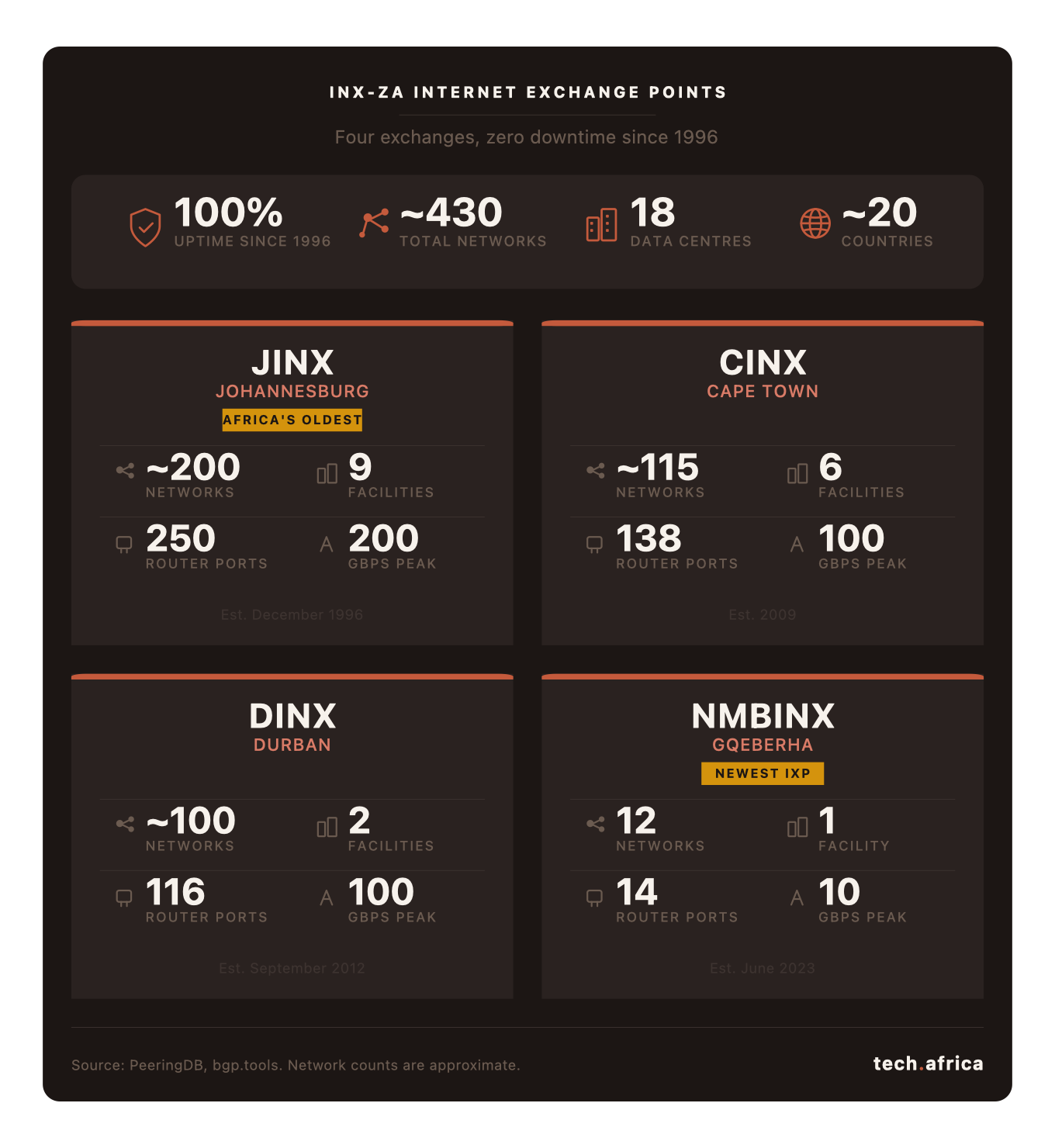
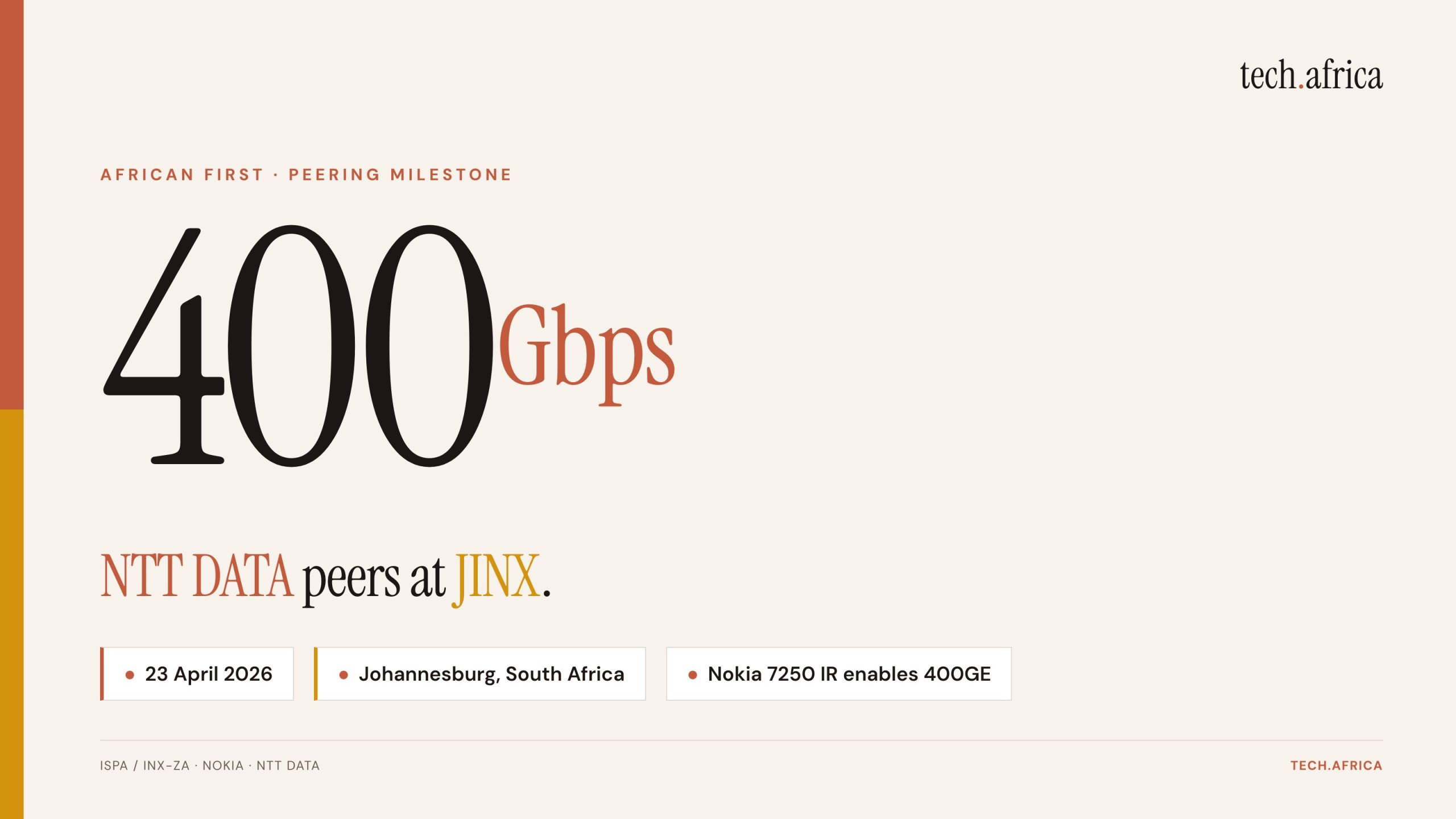
- JINX (Johannesburg), launched December 1996. Africa’s oldest IXP with close to 200 connected networks across 9 data centre facilities. A Nokia 400GE upgrade in 2025 made JINX one of the first exchanges in Africa to support 400 gigabit Ethernet.
- CINX (Cape Town), launched 2009, with over 110 connected networks across 6 facilities including the recently added Teraco CT2 in Brackenfell.
- DINX (Durban), launched September 2012, with close to 100 connected networks. Operates at NTT Data in Umhlanga and Teraco DB1 in Riverhorse Valley.
- NMBINX (Nelson Mandela Bay), launched June 2023 at NTT Data in Greenacres with 12 connected networks. The newest addition to the network.
The launch of NMBINX in 2023 signalled that INX-ZA’s expansion is not over. By extending peering infrastructure to a mid-sized metro outside the traditional Johannesburg-Cape Town-Durban corridor, the organisation is working to ensure that smaller cities benefit from the same local traffic exchange that the major metros have enjoyed for decades.
Across all four exchanges, the uptime record stands at 100%. Prenesh Padayachee, Chair of ISPA’s INX Committee, has described it as “astonishing” that the exchanges “have never experienced a single minute of downtime” in their history, a record that now approaches three decades.
What it costs to peer
Connecting to INX-ZA is open to any network with its own IP address space and an autonomous system number. Port fees are the exchange’s sole source of revenue, funding operations, infrastructure services, training, and advocacy for open internet access in the region.
| Port speed | Monthly cost |
|---|---|
| 1 Gbps | R1,495 |
| 10 Gbps | R2,995 |
| 100 Gbps | R17,495 |
| 400 Gbps | R34,990 |
There are no setup fees, and port fees at DINX and NMBINX have been waived entirely by the management committee. Critical infrastructure providers and non-profit organisations may also have fees waived. Most data centre operators hosting INX-ZA equipment, including NTT Data, xneelo, Africa Data Centres, and Digital Parks, have agreed to waive their monthly cross-connect charges, further lowering the barrier to peering. A formal contract is available but not required; adherence to the community’s technical policies is the primary expectation.
INX-ZA and NAPAfrica
INX-ZA is not South Africa’s only internet exchange. NAPAfrica, operated by Teraco, is a significant alternative with exchange points in Johannesburg, Cape Town, and Durban. The key distinction is INX-ZA’s data-centre-agnostic model: because its fabric spans multiple independent facilities, networks can peer without being tied to a single provider’s infrastructure or pricing. NAPAfrica, by contrast, operates exclusively within Teraco’s own data centres.
Community-run, continent-minded
INX-ZA is governed by a community-elected management committee and operates as an autonomous division of ISPA. It charges no cross-connect fees at most facilities and maintains strict security measures including MAC address locking, IRR filtering, and RPKI validation that drops invalid routes.
Beyond peering, the exchanges host instances of 5 DNS root servers through partnerships with organisations including ISC, Netnod, and PCH, and serve more than 400 top-level domains. INX-ZA also operates 8 NTP time servers distributed across all 4 cities, runs public RPKI route origin validators, and hosts RIPE ATLAS measurement anchors. These services, funded entirely by port fees, make the exchanges a piece of national internet infrastructure far broader than a simple traffic exchange.
The organisation has received support from the African Union Commission to help make internet exchange infrastructure more accessible across the continent. In a market where international bandwidth remains expensive and submarine cable capacity is finite, keeping domestic traffic domestic is not a technical footnote. It is the infrastructure layer that makes affordable, fast internet possible.
For ordinary South Africans, the effect is invisible but tangible. When a Vodacom subscriber in Durban watches a YouTube video, that traffic peers locally at DINX rather than routing through Johannesburg or overseas. The result is faster loading times, lower data costs for networks (savings that can be passed to consumers), and a more resilient internet that does not collapse when a single submarine cable is cut.
Nearly 30 years after a handful of South African ISPs decided to swap packets directly in a Johannesburg facility, the exchange they built has never stopped running.
Network operators interested in peering can find connection details and policies on the INX-ZA website. Real-time peering data is published on PeeringDB, and ISPA, the association that governs the exchanges, maintains resources for internet service providers across South Africa.


Leave a Reply