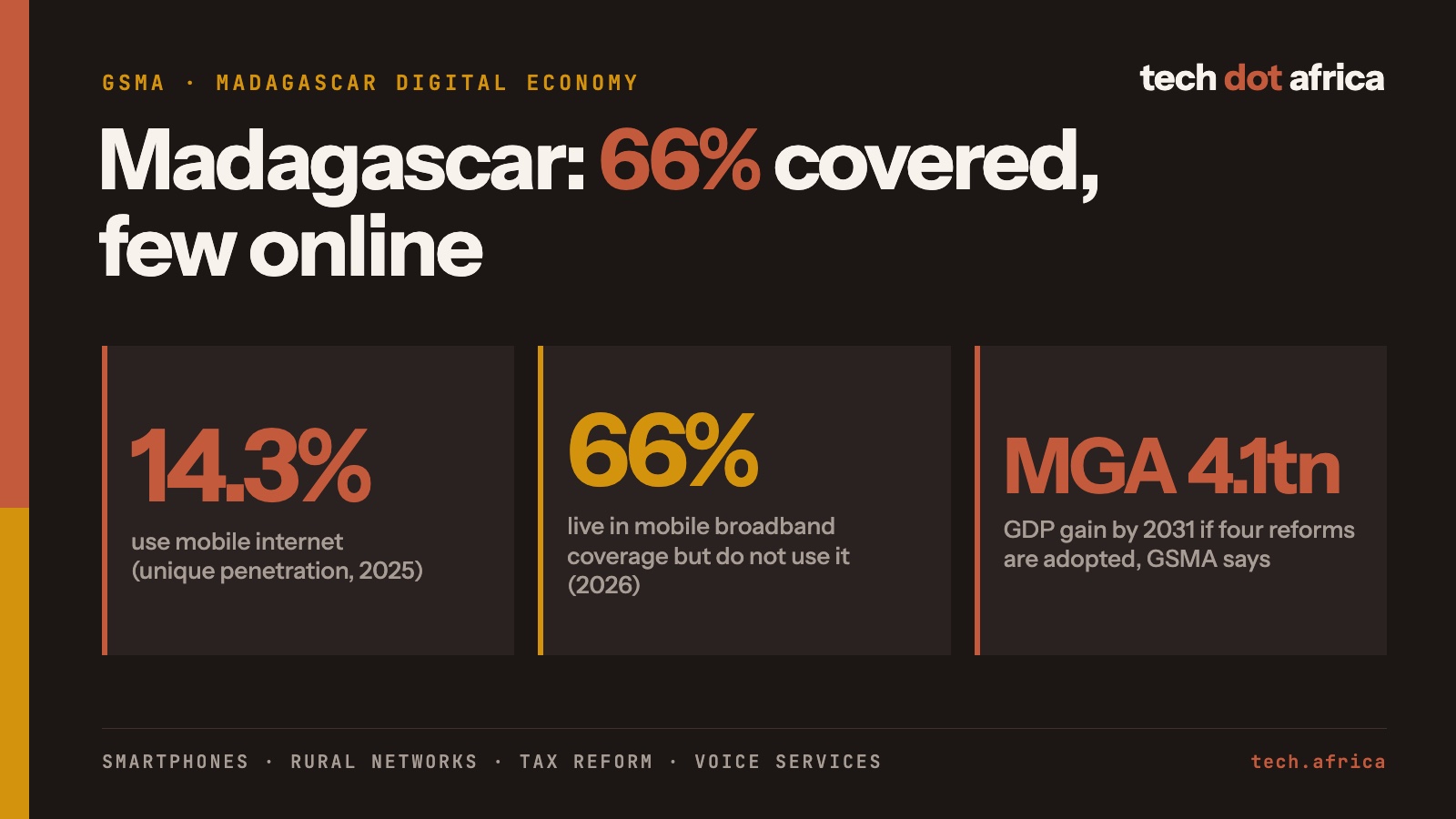
Only 14.3% of Madagascar’s population used mobile internet in 2025, and a GSMA report says 4 policy reforms could connect more than 1.1 million additional people and add MGA 4.1 trillion (Malagasy ariary) to GDP by 2031.
The GSMA (GSM Association), the mobile industry body, launched the report, Madagascar Digital Economy, at its Digital Africa Summit in Antananarivo, Madagascar, on 16 October 2026. A second report launched at the same event looks at spectrum policy across Africa.
Coverage has grown, use has not
Madagascar’s mobile connections rose from 12.3 million in 2021 to 22.5 million at the end of 2025, according to the GSMA. Unique mobile internet penetration remained low at 14.3% in 2025. In 2026, 66% of the population lived within mobile broadband coverage but did not use mobile internet.
The report names smartphone affordability and digital literacy as major barriers. About one-third of the rural population lives outside 4G coverage, which the GSMA attributes to difficult terrain, limited electricity, costly backhaul and high operating costs.
4 priorities
The report recommends 4 priorities that support Madagascar’s Digital Strategic Plan 2023–2028:
- Cheaper smartphones. Remove the 6% copyright fee, 20% import duty and 1% regulation levy on qualifying entry-level smartphones, add a targeted VAT exemption and expand device financing.
- Cheaper rural networks. Develop a costed Rural Connectivity Plan, make the funding mechanism transparent and results-based, and coordinate telecoms and electricity investment, including mini-grids anchored by mobile towers.
- Tax reform. Consider removing the 8% sector-specific excise duty, cut the 2% telecoms and ICT regulation tax to 1%, and zero-rate imports of essential broadband network and rural-site energy equipment.
- More useful services. Support voice-based services built on reliable Malagasy speech recognition, to reach people with limited literacy.
“Madagascar’s expanding mobile networks provide a strong foundation for digital transformation,” said Angela Wamola, Head of Africa at the GSMA.
Spectrum costs more in Africa
The second report, Spectrum Policy in Africa, finds that spectrum costs in Africa are on average 24% higher than elsewhere, measured against operator revenues and adjusted for the amount of spectrum assigned. It says pricing and licensing reforms could add more than $120 billion to African GDP between 2026 and 2035.
By 2035, the GSMA estimates the reforms could extend 4G to an additional 50 million people and 5G to an additional 170 million, and lift average download speeds by at least 30%. Its recommendations include prices that reflect spectrum’s forward-looking value, technology-neutral licences, licence terms of at least 20 years and long-term spectrum roadmaps.
The figures are the GSMA’s projections, and the body represents mobile operators that would be affected by the tax and spectrum changes it proposes. Affordability is already a pressure point elsewhere: rising memory prices are pushing Africa’s $30 smartphone out of reach, and spectrum pricing was a live issue when MTN won all the 3 GHz 5G spectrum Ghana offered.

Leave a Reply