
When AF-CIX, the Lagos-based internet exchange operated by Germany’s DE-CIX, confirmed on 5 May that Meta’s main network had gone live on its platform, the on-message takeaway was a single new exchange peering. The fuller picture, drawn from live BGP routing data, is more interesting: Meta peers at 27 active internet exchange points across ten African countries, totalling roughly 5.5 Tbps of port capacity, through a two-ASN architecture that splits content origin from edge caching. AF-CIX is the latest entry in a footprint that is markedly broader than Meta’s own self-reported peering record discloses.
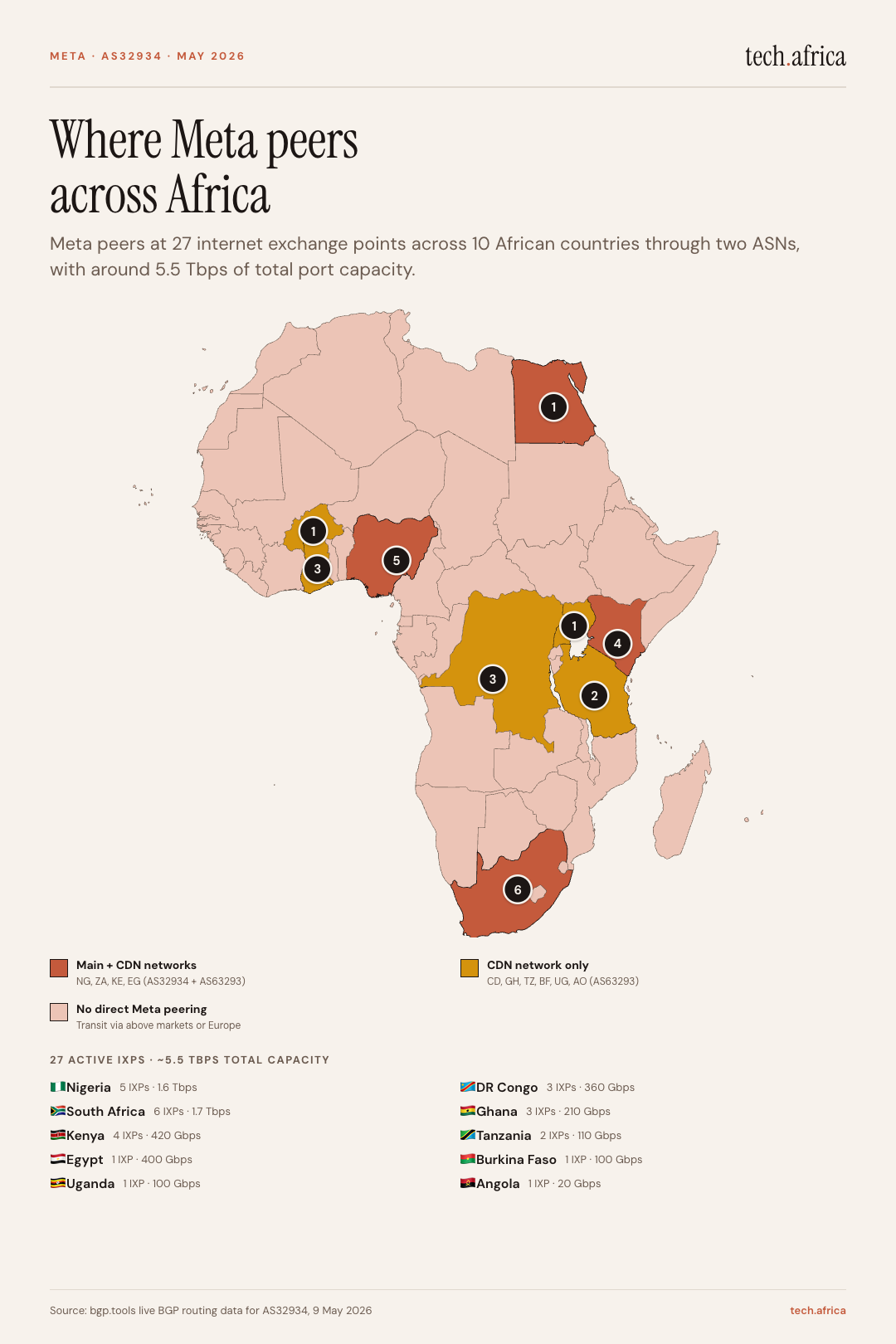
Two ASNs, two missions
Meta operates two distinct autonomous systems on the continent. AS32934 is the main content network. It is the routing identity behind Facebook, Instagram, WhatsApp and Messenger when those services originate traffic from Meta’s primary infrastructure. AS63293 is the Meta CDN network, the edge-cache and traffic-distribution layer that fronts the content network in markets where Meta has a measured presence but no primary deployment.
The split is a common hyperscaler pattern. Content origins prefer dense peering at major aggregations to keep the path to global infrastructure short. CDN nodes prefer a broad reach to keep cached content geographically close to end users. The same network operator runs both, but separating them into different ASNs gives each layer its own routing policy signature, makes capacity planning cleaner, and lets the operator publish distinct peering policies for each.
Mapped to Africa, the architecture produces a clear geographic split. AS32934 is present in only four countries: South Africa, Nigeria, Kenya, and Egypt. Those are the markets with enough commercial traffic and enough subsea cable redundancy to anchor a primary content deployment. AS63293 reaches a further six countries: DR Congo, Ghana, Tanzania, Burkina Faso, Uganda, and Angola. Those are the markets where Meta has decided cached content delivery is worth a direct peering presence even when full content origination is not.
The 27-IXP map
The country-level breakdown, with port capacities aggregated across both ASNs:
| Country | IXPs | Total Gbps | Networks present |
|---|---|---|---|
| South Africa | 6 | 1,900 | Main + CDN |
| Nigeria | 5 | 1,840 | Main |
| Kenya | 4 | 420 | Main + CDN |
| Egypt | 1 | 400 | Main |
| DR Congo | 3 | 360 | CDN only |
| Ghana | 3 | 210 | CDN only |
| Tanzania | 2 | 110 | CDN only |
| Burkina Faso | 1 | 100 | CDN only |
| Uganda | 1 | 100 | CDN only |
| Angola | 1 | 20 | CDN only |
South Africa accounts for almost a third of Meta’s African capacity at 1.9 Tbps across six exchanges. Nigeria is close behind at 1.84 Tbps, with almost all traffic concentrated in Lagos. Egypt’s single Cairo presence delivers 400 Gbps, the same as a mid-tier European primary exchange. Kenya is split between Mombasa (the main-network landing) and Nairobi (CDN only), with KIXP Nairobi reached via AS63293, even though Meta’s main network does not peer there.
Compared with Google
To put the Meta footprint in context, the same exercise repeated across every member ASN of the AS-GOOGLE routing-policy set produces a markedly smaller picture. Google operates 31 numbered ASNs in AS-GOOGLE, but only three of them peer at any African IXP: AS15169 (the primary Google network), AS36040 (Google Cache), and AS11344 (a legacy Google ASN). Together they cover 11 African IXPs across five countries, with around 1.5 Tbps of committed capacity.
| Operator | Active ASNs | African IXPs | Countries | Total capacity |
|---|---|---|---|---|
| Meta | 2 of 2 | 27 | 10 | ~5.5 Tbps |
| 3 of 31 | 11 | 5 | ~1.5 Tbps |
The numbers are striking, but they need a careful caveat. Public IXP peering is only one of three ways a hyperscaler can land traffic close to end users. The other two are Private Network Interconnect (PNI), in which the hyperscaler runs a private fibre cross-connect into a single carrier’s network at a colocation facility, and embedded caches, in which the hyperscaler ships physical cache servers into the ISP’s data centres. Google relies heavily on both. The Google Global Cache (GGC) programme deploys Google-owned cache servers within ISP networks across Africa, where they answer Google, YouTube, and Google Cloud queries within the ISP’s own routing perimeter. None of that traffic crosses an internet exchange. None of it appears in BGP-public-peering data.
So the comparison should be read as a public IXP strategy, not as a verdict on which company has invested more in Africa. Meta’s decision to peer broadly with public IXPs reflects, among other things, that its CDN traffic profile aligns well with neutral-exchange aggregation. Google’s decision to lean on PNI and embedded caches reflects the scale of YouTube and Google Cloud traffic, which justifies dedicated direct fibre to the largest African carriers. Both architectures move Meta and Google content closer to African end users. They just leave different fingerprints in the routing table.
Lagos as an African peering capital
Lagos accounts for the largest single-city Meta deployment on the continent. Across IXPN Lagos (1,200 Gbps via six 200 Gbps ports), AMS-IX Lagos (400 Gbps; launched as WAF-IX in 2023) and the newly-active AF-CIX (200 Gbps via two 100 Gbps ports), Meta’s main network runs 1.8 Tbps of committed capacity in one city, all on AS32934. Google adds its own Lagos presence at AS15169, plus a cache at AS36040 at IXPN, AMS-IX Lagos, IXPN Kano, and IXPN Abuja. No other African city carries this density of hyperscaler peering.
The reasons are mostly structural. Lagos sits at the landing point of multiple subsea cables (MainOne, WACS, Equiano, ACE, 2Africa, Glo-1) and hosts the largest single-country cluster of mobile and fixed-line subscribers on the continent. The regulator, NCC, pushed early for an active local IXP scene; IXPN’s expansion into Kano and Abuja is a direct consequence. The result is that any hyperscaler designing for West African coverage has to start in Lagos, and any decision to add another exchange there (as DE-CIX did with AF-CIX in 2023, and as other major IXP operators continue to do) lands on a market hungry for capacity.
The CDN’s longer reach
The clearest demonstration of why Meta runs two ASNs is the contrast between the main network’s four-country footprint and the CDN’s ten-country reach. AS63293 carries 100 Gbps into the Accra Internet Exchange LBG and LINX Accra in Ghana, BFIX Ouagadougou in Burkina Faso, UIXP in Kampala, and TIX Tanzania – Dar es Salaam. It runs 200 Gbps into Kinshasa’s KINIX, 100 Gbps into Lubumbashi’s LUBIX and 60 Gbps into Goma’s GOMIX. The DR Congo footprint, three exchanges across three cities, is more thorough than the country’s small population of indexed IXPs would suggest.
What this means in practice for an end user in Kampala or Accra: their request for an Instagram thumbnail is much more likely to be served from a Meta CDN cache via the local IXP than from Meta’s main network in Lagos or Johannesburg. The latency savings are in the range of 50 to 150 milliseconds for cache-hit content, depending on geography. For cache-miss content, the request still has to traverse the main network, but the local IXP provides Meta with a single, predictable transit path back to AS32934.
A note on data sources
The dataset behind this article cross-references three industry-standard sources, each serving a different purpose. PeeringDB is the voluntary, self-reported metadata source: it captures stated peering policy, contact information, max-prefix limits and route-server membership intent. It is the right reference for understanding what a network says it does. bgp.tools and bgp.he.net are observed-routing tools that report what the BGP routing table actually shows, drawn from public route collectors and the operators’ own vantage points. They are the right reference for understanding what a network is doing right now. The two layers complement each other; neither is a substitute for the other. For this article, the country-level numbers are drawn from bgp.tools-observed routing on 9 May 2026, with PeeringDB used to verify ASN ownership and bgp.he.net used as a sanity check on individual ASN records. Past undersea-cable incidents are also a reminder that observed-routing data is a snapshot: route flaps and cable cuts can change the picture day to day.
The latest data point: AF-CIX
AF-CIX confirmed on LinkedIn on 5 May 2026 that AS32934 was now live on its platform, with two 100 Gbps ports. The exchange described the development as a “significant step forward”, citing improved traffic localisation, reduced latency to Meta services and more efficient routing for the 38 networks already peering at AF-CIX. Read against the broader 27-IXP picture, AF-CIX’s go-live consolidates Lagos as the densest hyperscaler peering location in Africa rather than opening a new geography.
What it tells African networks
For a network operator deciding which exchanges to join, the practical implication of Meta’s footprint is straightforward: the public-IXP route to Meta is well-served if your network is already in Lagos, Johannesburg, Cape Town, Cairo, Mombasa, Nairobi, Kinshasa, Accra, Dar es Salaam, Kampala, Ouagadougou or Luanda. Outside those cities, transit through one of those markets or to Europe remains the path. The CDN ASN extends Meta’s reach beyond the main network, but neither replaces the broader pattern that density follows commercial traffic, and that traffic follows density.
Coming up in this series
This is the first piece in a five-part series mapping how the major content and cloud hyperscalers peer across African internet exchange points. Next: Inside Google’s African network, expanding on the AS-GOOGLE footprint introduced here and explaining why public IXP peering tells only part of Google’s African connectivity story. Then, in turn, Microsoft, Amazon, and Cloudflare. By the end of the series, the comparison table will cover all five operators, with a combined-view capstone if the data warrants it.




Leave a Reply