Satellite operator Starlink now delivers faster median download speeds than local internet providers in almost every African market where it operates, according to new data from internet-measurement firm Ookla.
The findings come from an analysis by Karim Yaici, an industry analyst at Ookla, drawing on Speedtest Intelligence measurements across 23 African markets in the first quarter of 2026. The report tracks how the company’s performance has shifted as it builds out ground infrastructure on the continent.
Speeds climb past 50 Mbps in most markets
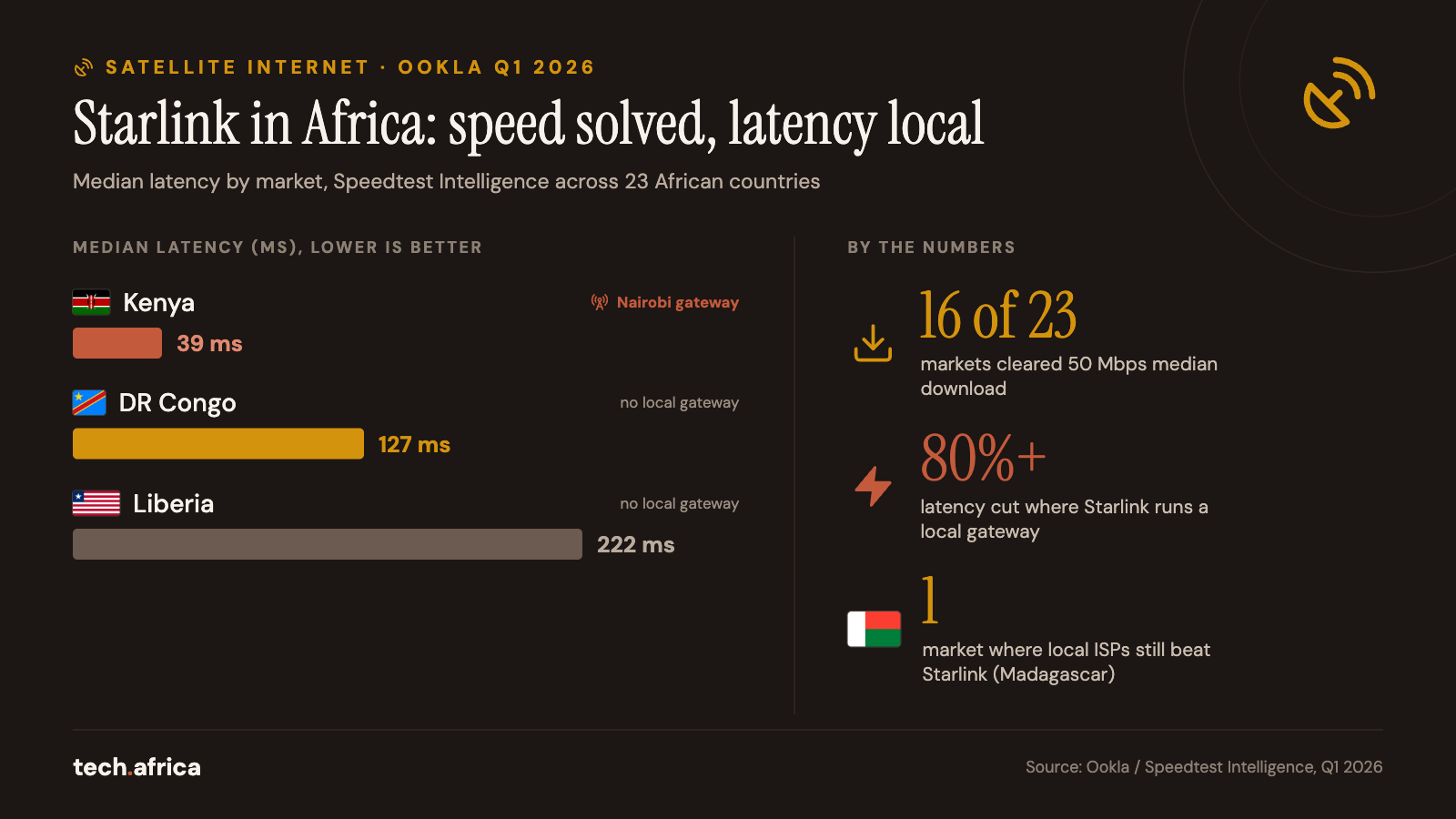
Starlink exceeded a median download speed of 50 Mbps in 16 of the 23 countries Ookla measured. Three markets went further: Eswatini, Botswana and Senegal each cleared 100 Mbps.
Performance was uneven by region. Central Africa recorded the sharpest improvement, approaching 100 Mbps, while parts of East Africa saw median speeds slip over the same period.
In nearly every market, Starlink’s median download speed outpaced that of local fixed and mobile providers. Madagascar was the lone exception, where terrestrial operators still held the lead.
Local gateways slash latency
The bigger shift was in latency, the delay before data starts moving. Starlink has deployed dedicated Points of Presence (PoPs), local network gateways, in Johannesburg, South Africa and Nairobi, Kenya.
Those gateways cut latency by more than 80% in the markets they serve. Kenya now records the lowest latency on the continent at 39 milliseconds (ms), far below the figures seen when traffic is routed to distant gateways.
The contrast with unserved markets is stark. The Democratic Republic of Congo, with no local gateway, has a latency of 127 ms, while Liberia trails at 222 ms. Traffic from those countries still routes to distant gateways before reaching the wider internet.
A partner for operators, not just a rival
Ookla frames satellite less as a threat to African telecoms and more as a complement. The report points to opportunities in mobile backhaul, which carries traffic between cell sites and the core network, and in Direct-to-Device (D2D) services that let standard phones connect to satellites.
That thesis is already being tested. MTN Zambia became the first African operator to trial Starlink’s Direct-to-Cell service, while Vodacom has signed a deal with Amazon’s Leo constellation to extend mobile coverage into rural areas.
For operators, the appeal is closing the rural connectivity gap without laying fibre to every village, while monetising new services on top of the networks they already run.
Regulation still shapes the map
Where Starlink can operate remains a licensing question. The Independent Communications Authority of South Africa (ICASA) recently opened its satellite spectrum rules for public comment, a process that will help set the terms on which low-Earth-orbit operators reach the country’s users.
Ookla’s wider measurements suggest the groundwork is still being laid: the firm also found that most African networks still run on Wi-Fi 4 and the congested 2.4 GHz band. As Starlink adds gateways and operators strike backhaul deals, the divide between connected and underserved markets may come down to where the next PoP lands.


Leave a Reply