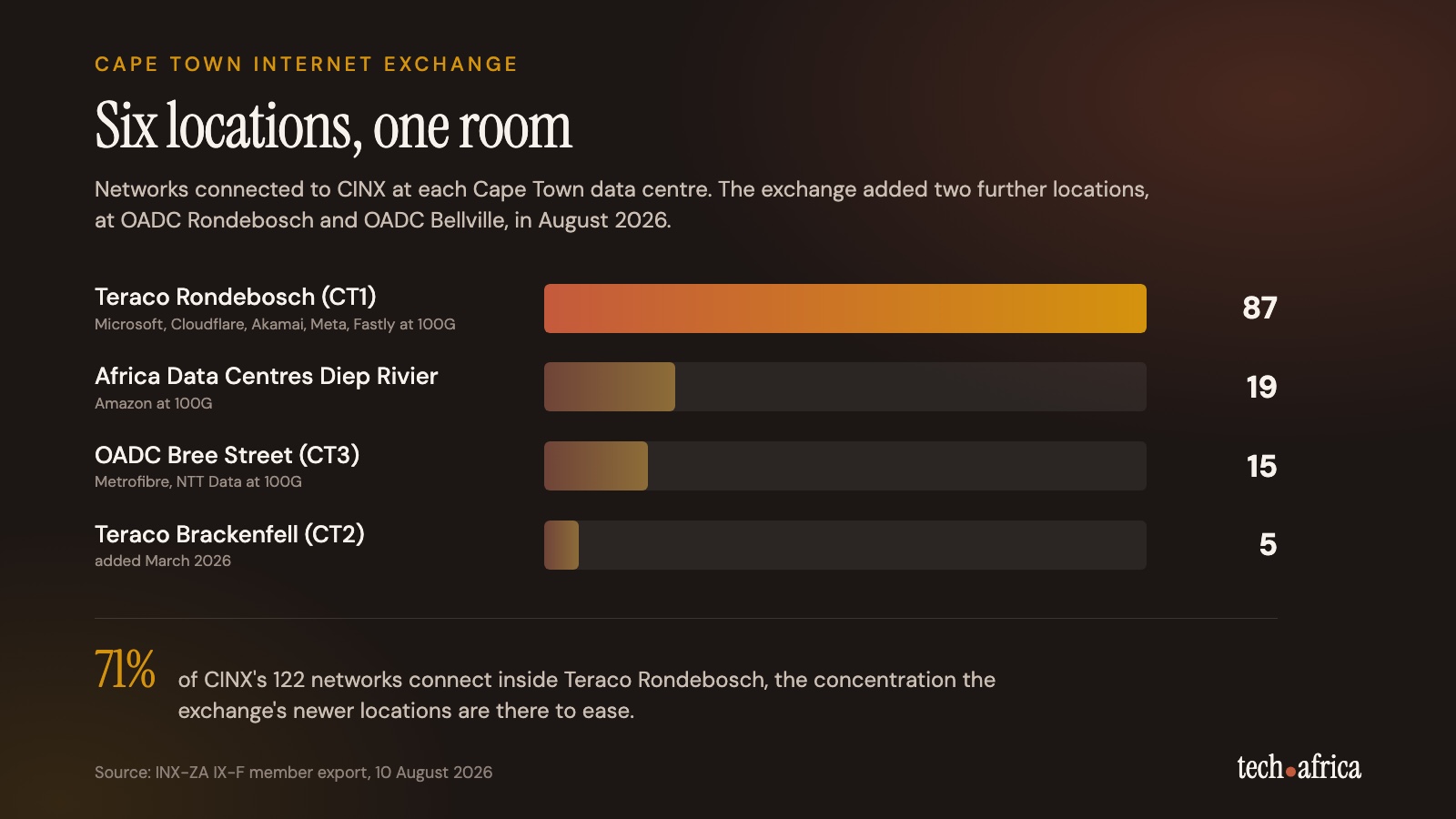
Cape Town’s internet exchange now reaches 6 data centres. It is the sort of expansion that only pays off slowly, because 87 of the exchange’s 122 connected networks currently sit in a single building.
South African exchange operator INX-ZA announced on 3 August 2026 that CINX, the Cape Town Internet Exchange, had gone live inside two Open Access Data Centres sites in Cape Town, South Africa. An internet exchange is the shared switching fabric where networks exchange traffic directly, a practice called peering, instead of paying a transit provider to carry it.
Key takeaways
- CINX added nodes at OADC Rondebosch and OADC Bellville, bringing the total to 6 Cape Town locations.
- Teraco Rondebosch holds 87 of CINX’s 122 networks, or 71%, and nearly every 100 Gbps content port.
- CINX carries 153 ports and about 3,897 Gbps in total, against 10,132 Gbps at INX-ZA’s Johannesburg exchange.
- The deployment crew included a 19-year-old volunteer, whom INX-ZA highlighted in the announcement.
Which CT1 and CT2
The announcement refers to OADC CT1 and CT2. Those are the operator’s own site codes, and they are easy to confuse with the Teraco buildings of the same designation, which CINX already occupies.
INX-ZA’s member export names the new switches precisely: psw1.ron at Open Access Data Centres Rondebosch, and psw1.bel at Open Access Data Centres Bellville. Teraco’s Rondebosch and Brackenfell sites are separate facilities that CINX has served for longer, the latter added as its fourth location in March 2026.
Where Cape Town’s peering lives
The distribution across CINX’s established sites is lopsided. Teraco Rondebosch holds 87 networks. Africa Data Centres Diep Rivier has 19, OADC Bree Street has 15, and Teraco Brackenfell has 5.
The concentration is starker in capacity than in headcount. Almost every 100 Gbps port on the exchange terminates in Rondebosch, including those of Microsoft, Cloudflare, Akamai, Meta, Fastly, mobile operator Vodacom, subsea cable operator SEACOM and mobile network rain.
The exceptions are few. Amazon takes 100 Gbps at Diep Rivier, and South African network operator group ZANOG and fibre provider fibertime hold 100 Gbps ports at Brackenfell.
That is the case for spreading the fabric. A peering ecosystem whose members are overwhelmingly in one room inherits that room’s risks, and every additional on-ramp gives networks somewhere else to connect.
Cape Town against Johannesburg
CINX carries 122 networks across 153 ports and about 3,897 Gbps of connected capacity. INX-ZA’s Johannesburg exchange, JINX, carries 208 networks across 289 ports and 10,132 Gbps, spread over 9 facilities.
Johannesburg is both larger and better distributed, which is what a longer build-out buys. JINX has been extending in the same way, reaching Equinix JN1 in March 2026, and has since drawn new members including content delivery network CDN77.
Cape Town’s ecosystem has been thickening on other fronts too. ZANOG and NAPAfrica deployed a community cache cluster in the city in May 2026.
The 19-year-old on the deployment
INX-ZA used most of its announcement to talk about someone other than the equipment. Ryan Osborne, a first-year computer science student, volunteered for the exchange a few months ago and was on-site helping to install the new nodes.
“A teenager, still in his first year at university, hands-on in a live Internet exchange deployment, pulling cables, configuring infrastructure, and contributing to the backbone of South Africa’s Internet,” the exchange said.
INX-ZA framed it as a recruitment argument. “Everybody complains about finding skilled staff,” it said, arguing that the way to grow the continent’s network engineering community is to give young people access to real infrastructure and real mentorship early.
The organisation is a non-profit run largely by volunteers, a model it has relied on throughout its history. It also thanked longtime contributor Hendrik Visage for work on the extensions, and said its doors remain open to students and volunteers.
How these figures were compiled
Member counts, port speeds and facility locations come from INX-ZA’s IX-F member export, pulled on 10 August 2026, and the expansion itself from the operator’s announcement of 3 August 2026.
The export is first-party data rather than a third-party directory, making it the strongest available source for who is connected to whom. One limit applies throughout: a connected port shows provisioned capacity, not the traffic actually crossing it.
Whether Cape Town’s peering fabric is genuinely distributed will be reflected in that same file over the coming months, as networks take up the new on-ramps.



Leave a Reply