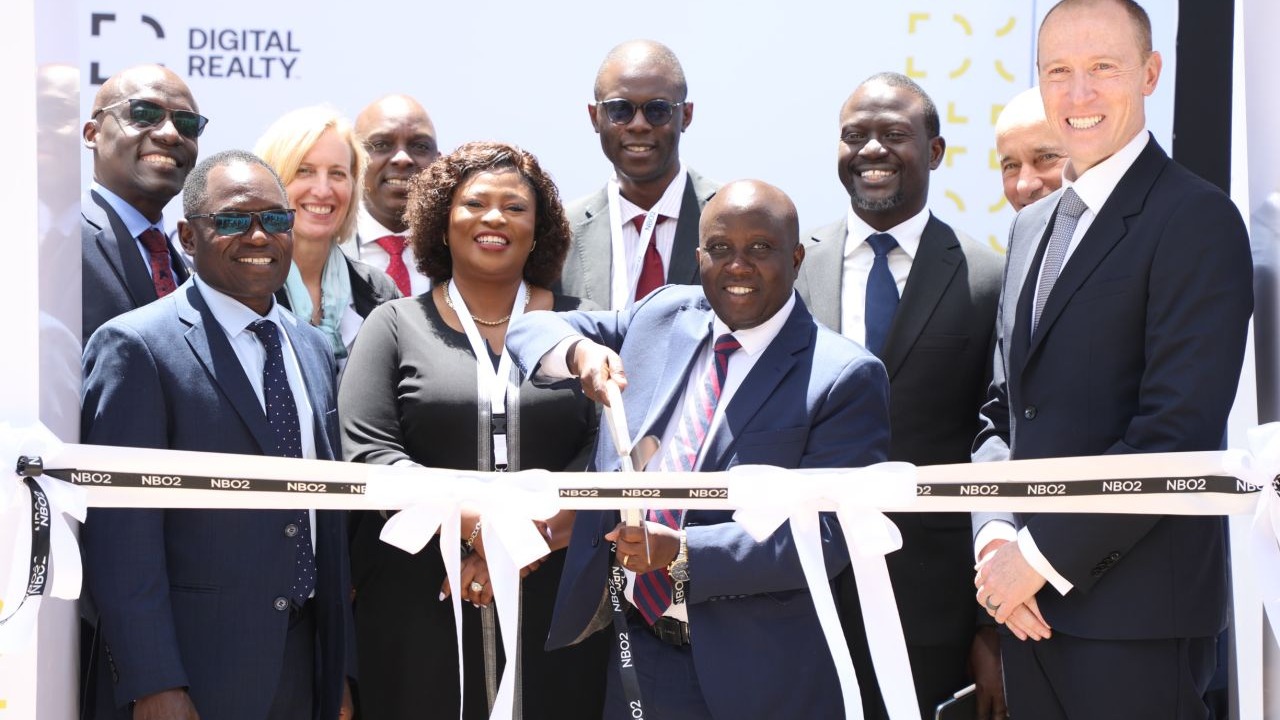
Nairobi, Kenya, gained 6.4 megawatts (MW) of data centre capacity on 7 September 2026, and lost a brand on the same day.
Digital Realty, the American data centre operator that trades on the New York Stock Exchange as DLR, announced the opening of its Nairobi Two facility, NBO2, alongside the existing Nairobi One site. In the same statement the company confirmed that iColo, the Kenyan operator now inside the group, will trade under the Digital Realty name in both Kenya and Mozambique.
What NBO2 adds
NBO2 is built beside NBO1 and extends what Digital Realty describes as a campus rather than a single building. The company said customers on the campus can reach more than 100 networks, two internet exchange points (IXPs) and a satellite teleport, the last of which it presents as a route to locations where terrestrial fibre is thin.
Neither the capital cost nor the phasing of the 6.4 MW was disclosed. The company also did not name the two exchanges on the campus, nor say how much of the new capacity is already contracted.
“The opening of NBO2 and our transition to Digital Realty are part of one story: the continued growth of Kenya’s digital economy and iColo’s evolution within a global platform,” said Wanja Muriithi, country general manager for Kenya at Digital Realty.
The iColo name goes in two countries, not one
iColo reached Digital Realty by inheritance rather than by direct purchase. Interxion completed the acquisition of a 40% stake in the Kenyan operator on 17 April 2019, and Digital Realty completed its own combination with Interxion on 12 March 2020, both dates recorded in the company’s filings with the United States Securities and Exchange Commission. The Kenyan business has therefore been part of the group for more than six years under a name that is only now being withdrawn.
The rebrand is the more consequential half of the announcement for the region, because it covers Mozambique as well as Kenya. iColo built the Maputo site that carries the group’s Mozambican presence, and it operates two facilities in Mombasa in addition to the Nairobi campus.
Local brands acquired by global platforms usually survive for a period precisely because the local name carries the customer relationships. Dropping it in two markets at once signals that Digital Realty now expects the global name to do that work, and it closes the book on an operator that built much of the Kenyan colocation market the group now serves.
Where Nairobi’s peering density actually sits
The claim worth testing is the interconnection one. Kenya Internet Exchange Point (KIXP) publishes which of its members take a port at which building, and that list is a measure of peering gravity rather than floor space.
As of 7 September 2026, it lists 130 networks at Africa Data Centres’ Nairobi facility, compared with 15 at NBO1, 9 at PAIX Kenya, and 4 at iXAfrica’s NBOX1. Digital Realty’s “more than 100 networks” refers to everything reachable across the campus, including carriers and cloud on-ramps, so the two figures measure different things. They still point the same way: Nairobi’s exchange traffic concentrates at a rival’s address, and capacity alone does not move it.
That is the number to watch over the next year. Peering density is sticky; it accrues slowly, and it is the difference between a building that holds servers and one that anchors a market.
Who was in the room
The guest list at the Nairobi ceremony is worth reading, because it says more about how this investment is being positioned than the capacity figure does.
Digital Realty listed the Kenyan state across three of its arms: John Tanui, principal secretary in the State Department for ICT; David Mugonyi, director general of the Communications Authority of Kenya; and John Walubengo, the deputy data protection commissioner. Philip Thigo, Kenya’s special envoy on technology, also attended.
So did the United States. Frank Garcia, sworn in as assistant secretary of state for African affairs on 1 June 2026, attended alongside Susan M. Burns, chargé d’affaires at the American embassy in Nairobi. The State Department’s own public schedule had Garcia travelling in Zambia, Ethiopia and Kenya between 30 August and 10 September. A serving assistant secretary of state at the opening of a commercial data centre is not routine diplomatic business, and it reflects how far digital infrastructure has climbed the agenda between Washington and African capitals.
The local industry was represented by Fiona Asonga, chief executive of the Technology Service Providers of Kenya, which runs KIXP and hosts the Kenya Peering Forum in Nairobi on 11 September, and by James Turuthi of Frontier Optical Networks and KeNIC. Michael Jacobs of Remgro Infrastructure Managers attended for the investor side.
The presence of the data protection regulator alongside the ICT ministry is the clearest signal of what the company is selling here. The pitch is not cheap racks. It is Kenyan data, kept in Kenya, next to the networks and clouds that need to reach it.
The African estate Digital Realty has assembled
Kenya and Mozambique join a footprint built almost entirely by acquisition, and on the public record it is the largest interconnection estate in Africa. Digital Realty took a 55% stake in South Africa’s Teraco in 2022, holds the former Medallion sites in Lagos and Abuja bought the year before, runs a facility in Accra and a new build at Lekki outside Lagos, and operates the Lisbon campus it positions as a landing point for African traffic.
According to PeeringDB, where operators register their own sites, the group runs 14 data centres in five African countries, carrying roughly 1,050 network records between them. The nearest comparisons on the same register are Africa Data Centres with 5 African sites and 195 records, Raxio with 6 sites and 22, and Equinix with 4 and 107. tech.africa’s own infrastructure graph, which derives presence from exchange member lists rather than self-registration, finds 709 distinct networks inside Digital Realty buildings; a network present in two countries is counted once there and twice in the table below.
| Country | Digital Realty facilities | Networks measured on site |
|---|---|---|
| South Africa | Teraco (5 sites incl. Johannesburg and Bredell campuses, CT1, CT2, DB1) | 656 |
| Nigeria | Lagos LOS1-2, Abuja, Lekki LKK1-2 | 40 |
| Kenya | NBO1, NBO2, Mombasa MBA1 and MBA2 | 34 |
| Ghana | Accra ACR2 | not yet measured |
| Mozambique | Maputo MPM1 | not yet measured |
The concentration is stark. Teraco’s Johannesburg campus alone lists 390 networks in PeeringDB, more than a third of the group’s African total and, by some distance, its densest site on the continent. It is also the campus that hosts NAPAfrica, Africa’s largest exchange by membership. Nairobi is the second front, and it is an order of magnitude smaller.
NBO2 opens nearly empty, which is normal
PeeringDB currently records two networks at NBO2, against 62 at NBO1 next door and 94 at the older Mombasa site. That is not a criticism of a building that opened this week: interconnection is contractual, and cross-connects follow tenants over quarters rather than days.
It does frame the question the campus now faces. The 6.4 MW has been built, and the neighbouring building already supports the ecosystem. Whether NBO2 is filled with networks or simply with racks determines the difference between an extension of the Nairobi interconnection point and a well-connected warehouse.
The Kenyan sites have been quietly busy through that period. LINX launched its Nairobi exchange in partnership with iColo in 2023, and KIXP interconnected its two Mombasa data centres this year, both of which are iColo buildings now carrying a new name.
What the company has not yet said is whether the Digital Realty brand will extend further in Africa, or whether Teraco, by far its largest asset on the continent, will keep its own name indefinitely.

Leave a Reply