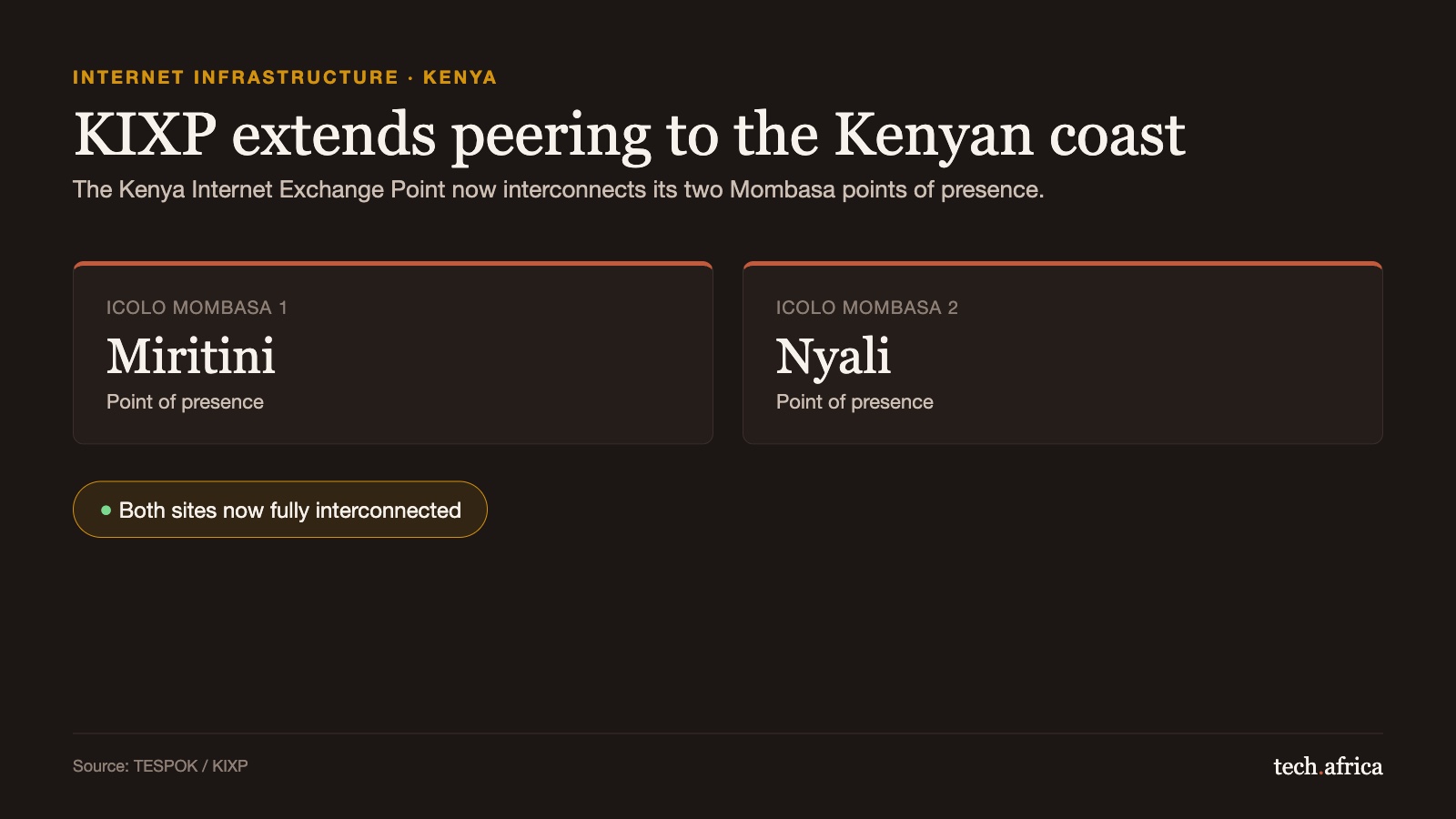
Kenya’s main internet exchange has knitted together its two coastal sites, extending resilient local peering beyond Nairobi to Mombasa.
TESPOK, which operates the Kenya Internet Exchange Point (KIXP), said on 12 May 2026 that its two Mombasa points of presence (PoP) are now fully interconnected. They sit in data centres run by ICOLO, a Digital Realty company, at Miritini (ICOLO Mombasa 1) and Nyali (ICOLO Mombasa 2).
An internet exchange point (IXP) allows networks to exchange traffic directly rather than routing it through third parties abroad. Linking the two Mombasa sites means traffic can pass between them locally, which TESPOK says improves resilience and redundancy for connected networks. If one site loses power or connectivity, members can keep exchanging traffic through the other.
Why the coast matters
Mombasa is Kenya’s main subsea-cable landing point, where several international cables come ashore. Concentrating peering capacity there, rather than only in Nairobi, keeps more coastal traffic local and shortens the path between networks and the content they exchange. Mombasa’s cables also serve landlocked neighbours, which makes interconnection in the coastal region regionally significant.
TESPOK described the setup as a distributed model that supports more efficient traffic exchange while extending local interconnection beyond the capital. It echoes a wider regional pattern, with exchanges expanding peering and caching outside their home cities.
KIXP’s move follows other coastal activity, including the launch of LINX Mombasa, as Kenya builds out interconnection capacity along its seaboard.
With both Mombasa sites live and interconnected, KIXP now gives networks on the coast an alternative to backhauling their traffic to Nairobi simply to peer.


Leave a Reply