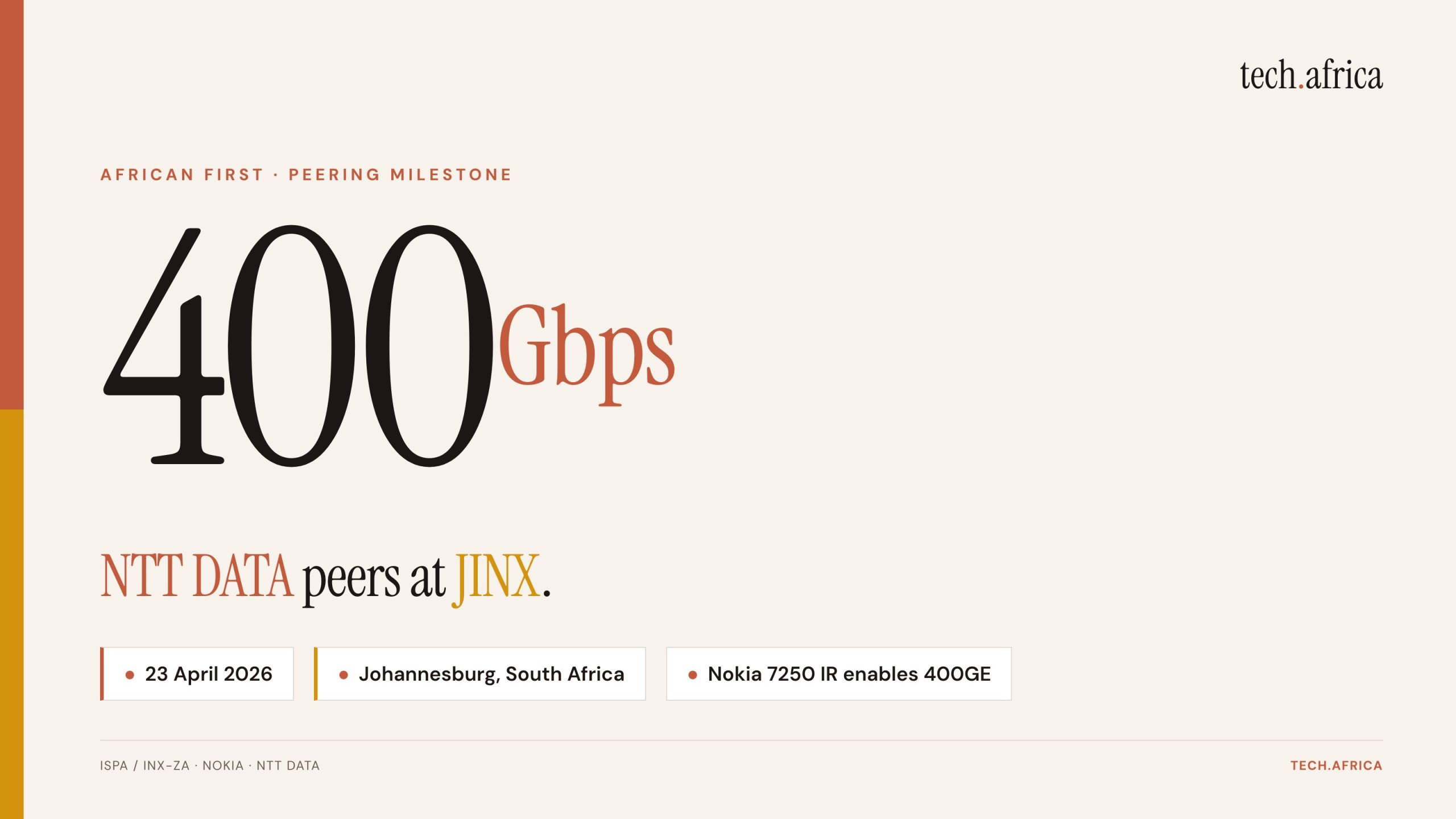
For the first time, an internet service provider on the African continent has peered at 400 gigabits per second. NTT DATA activated 400 Gbps peering at the Johannesburg Internet Exchange (JINX) on 23 April 2026, in a step that puts South Africa on par with the most advanced peering environments in Europe, Asia and North America.
JINX is the oldest internet exchange point on the continent, operating since 1996, and is run by INX-ZA, the exchange-point arm of South Africa’s Internet Service Providers’ Association (ISPA). The exchange spans ten data centres across Johannesburg and reports a 100% uptime record. NTT DATA, the global digital and IT services subsidiary of Japan’s NTT Group, is the first operator to bring a 400-gigabit Ethernet (400GE) port live at any public internet exchange in Africa.
The Nokia backbone behind the milestone
The 400 Gbps capability is the result of an INX-ZA infrastructure refresh in mid-2025, during which the exchange selected Nokia’s 7250 Interconnect Router platform as the basis for its next-generation switching fabric. Tech.africa first covered the partnership in Nokia to modernise South Africa’s internet exchanges, and tech.africa’s Inside INX-ZA feature in March 2026 documented the upgrade as having made JINX one of the first African exchanges to support 400GE. The same Nokia silicon anchors backbones at hyperscalers and Tier-1 IXPs in Europe and North America.
“Africa’s internet traffic has been growing exponentially, and the appetite for capacity, resilience, and low-latency connectivity has never been greater. Moving to 400 Gbps peering at JINX is a direct response to that demand. This is not just a technical upgrade; it is a statement of intent,” JC Burger, Director of Infrastructure Engineering and Operations at NTT DATA, said in the announcement.
Where this sits in the African peering arms race
The activation lands at a moment of unusually rapid expansion at South African internet exchanges. INX-ZA itself opened a new JINX point of presence at Equinix JN1 in March 2026 and added Cape Town capacity at Teraco Brackenfell shortly before that. Across town at Africa Data Centres, the rival NAPAfrica exchange passed 5 Tbps of aggregate traffic in early 2025 on a similar growth path, even if NAPAfrica has not yet announced an individual 400GE peer.
NTT DATA’s announcement makes the demand-side picture clear: the company is not buying 400 Gbps capacity for tomorrow’s Africa; it is buying it because today’s customer base is already pushing older 100 Gbps ports.
What 400 Gbps actually buys
A 400 Gbps peering port can sustain roughly four times the traffic of the 100GE ports that have been the workhorse of African IXPs since the late 2010s. For a major service provider, that translates into headroom to absorb continued traffic growth without re-engineering the peering edge every 12 months, lower latency for content delivery to South African end users, and more local termination of traffic that previously had to leave the continent.
The milestone matters beyond a single operator because hyperscalers and content delivery networks tend to follow a major peer’s port upgrade with their own. The exchange’s gravitational pull is increasingly a function of which networks are present at which speeds, not just total traffic volume.
JINX now joins a small global list of exchanges with active 400 Gbps peering. The questions for the next 12 months are how quickly other South African networks follow NTT DATA’s port upgrade, and whether the wider African market, in Lagos, Nairobi and beyond, faces pressure to upgrade its peering infrastructure in response.



Leave a Reply