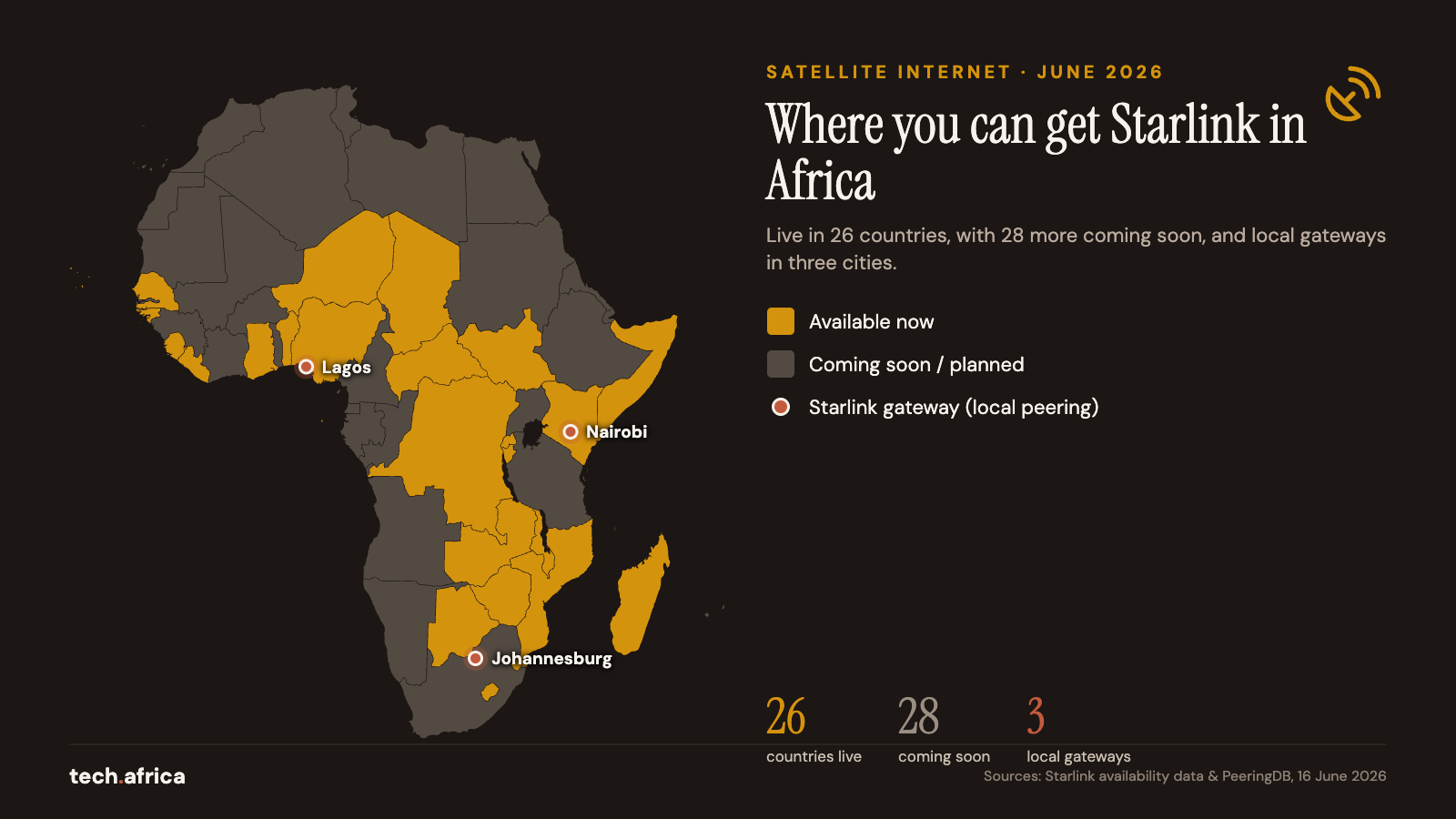
Starlink has become a default way to get online across much of rural Africa, but its map is uneven. As of June 2026 the SpaceX satellite service is live in 26 African countries, is promised in 26 more, and remains conspicuously absent from the continent’s most developed economy, South Africa.
This guide sets out where you can get Starlink in Africa, what it costs, how fast it actually is, and why some of the biggest markets are still waiting. The availability and pricing below come from Starlink’s own systems, checked on 16 June 2026. These figures change often.
Last updated: 16 June 2026.
Key takeaways
- Starlink is live in 26 African countries and listed as coming to 26 more. South Africa is not yet available.
- Monthly Residential plans run about $30 to $55 across the live markets; the hardware kit is the largest upfront cost.
- Median download speeds top 100 Mbps in every live market, with latency of 25 to 42 ms.
- Performance is anchored by ground gateways in Johannesburg, Lagos and Nairobi.
- South Africa remains blocked by B-BBEE ownership rules, though an investment-based workaround is now on the table.
Where Starlink is available in Africa
Starlink’s own availability data splits the continent into a few groups: live now, coming soon, and a couple of markets where the company has not committed to a timeline. Nigeria was the first African market, live since early 2023, and the list has grown steadily since.
| Status | Countries |
|---|---|
| Live now (26) | Benin, Botswana, Burundi, Cabo Verde, Central African Republic, Chad, DR Congo, Eswatini, Ghana, Guinea-Bissau, Kenya, Lesotho, Liberia, Madagascar, Malawi, Mozambique, Niger, Nigeria, Rwanda, São Tomé and Príncipe, Senegal, Sierra Leone, Somalia, South Sudan, Zambia, Zimbabwe |
| Coming in 2026 (19) | Angola, Burkina Faso, Cameroon, Comoros, Congo-Brazzaville, Côte d’Ivoire, Equatorial Guinea, Gabon, Gambia, Guinea, Mali, Mauritania, Mauritius, Namibia, Seychelles, Tanzania, Togo, Tunisia, Uganda |
| Planned, no date (7) | Algeria, Djibouti, Eritrea, Ethiopia, Libya, South Africa, Sudan |
| Status unclear (2) | Egypt, Morocco |
Several large economies sit on the waiting list rather than the live one. Tanzania, Uganda, Angola and Namibia are all marked as coming during 2026, while South Africa, Ethiopia and Sudan carry no committed date at all.
Why the rollout is uneven
Starlink covers the continent from orbit, so the patchwork is not about where its satellites reach. It comes down to two things on the ground: licences and gateways. Every country has to authorise the service, and approvals move at the pace of each national regulator, which is why neighbours can sit in different groups.
The second factor is ground infrastructure. Starlink routes traffic through gateway stations, and a market served by a nearby gateway gets lower latency and more capacity than one routed to a distant one. As the company adds gateways and clears the regulatory paperwork, the live list grows, but the order is shaped by politics and plumbing as much as by demand.
How much Starlink costs in Africa
Pricing is set per country in local currency and varies widely. There are two hardware options, the full-size Standard kit and the smaller, portable Mini, and in many markets two service tiers: standard Residential and a cheaper, lower-priority Residential Lite.
| Market | Residential /mo | Lite /mo | Standard kit | Mini kit |
|---|---|---|---|---|
| Nigeria (NGN) | 57,000 | – | 590,000 | 318,000 |
| Kenya (KES) | 6,500 | 4,000 | 49,900 | 27,000 |
| Ghana (GHS) | 770 | 500 | 4,100 | 2,200 |
| Rwanda (RWF) | 60,000 | 40,000 | 549,000 | 260,000 |
| Mozambique (MZN) | 3,000 | 1,900 | 22,000 | 12,800 |
| Zambia (ZMW) | 1,160 | 800 | 10,290 | 5,250 |
| Senegal (XOF) | 30,000 | 22,000 | 146,000 | 117,000 |
| Liberia (USD) | 55 | 45 | 390 | 200 |
| Zimbabwe / South Sudan (USD) | 50 | 30 | 389 | 200 |
| Somalia (USD) | 70 | – | 390 | 200 |
In dollar terms the monthly cost clusters around $30 to $55 for the standard Residential plan: roughly $37 in Nigeria and $50 in Kenya. The markets priced directly in US dollars, Liberia, Somalia, South Sudan and Zimbabwe, are among the cheapest and clearest. Exchange rates move, so treat dollar equivalents as a guide; the local-currency prices above are what Starlink actually charges.
On the tiers: Residential Lite is cheaper but slows first during congestion, and several Central and West African markets instead sell a capped Residential 250GB plan. The Mini kit costs less up front but is built for portability rather than as a full home setup.
How fast is Starlink in Africa?
Speeds are strong across the live markets. Starlink’s own reported median figures put most African countries well above typical fixed-line broadband, with low latency to match.
| Country | Download (median) | Upload | Latency |
|---|---|---|---|
| Somalia | 271 Mbps | 42 Mbps | 27 ms |
| Rwanda | 267 Mbps | 37 Mbps | 27 ms |
| Mozambique | 226 Mbps | 30 Mbps | 31 ms |
| Zambia | 181 Mbps | 24 Mbps | 38 ms |
| Kenya | 172 Mbps | 34 Mbps | 25 ms |
| Ghana | 172 Mbps | 18 Mbps | 31 ms |
| Zimbabwe | 159 Mbps | 21 Mbps | 35 ms |
| Nigeria | 125 Mbps | 17 Mbps | 28 ms |
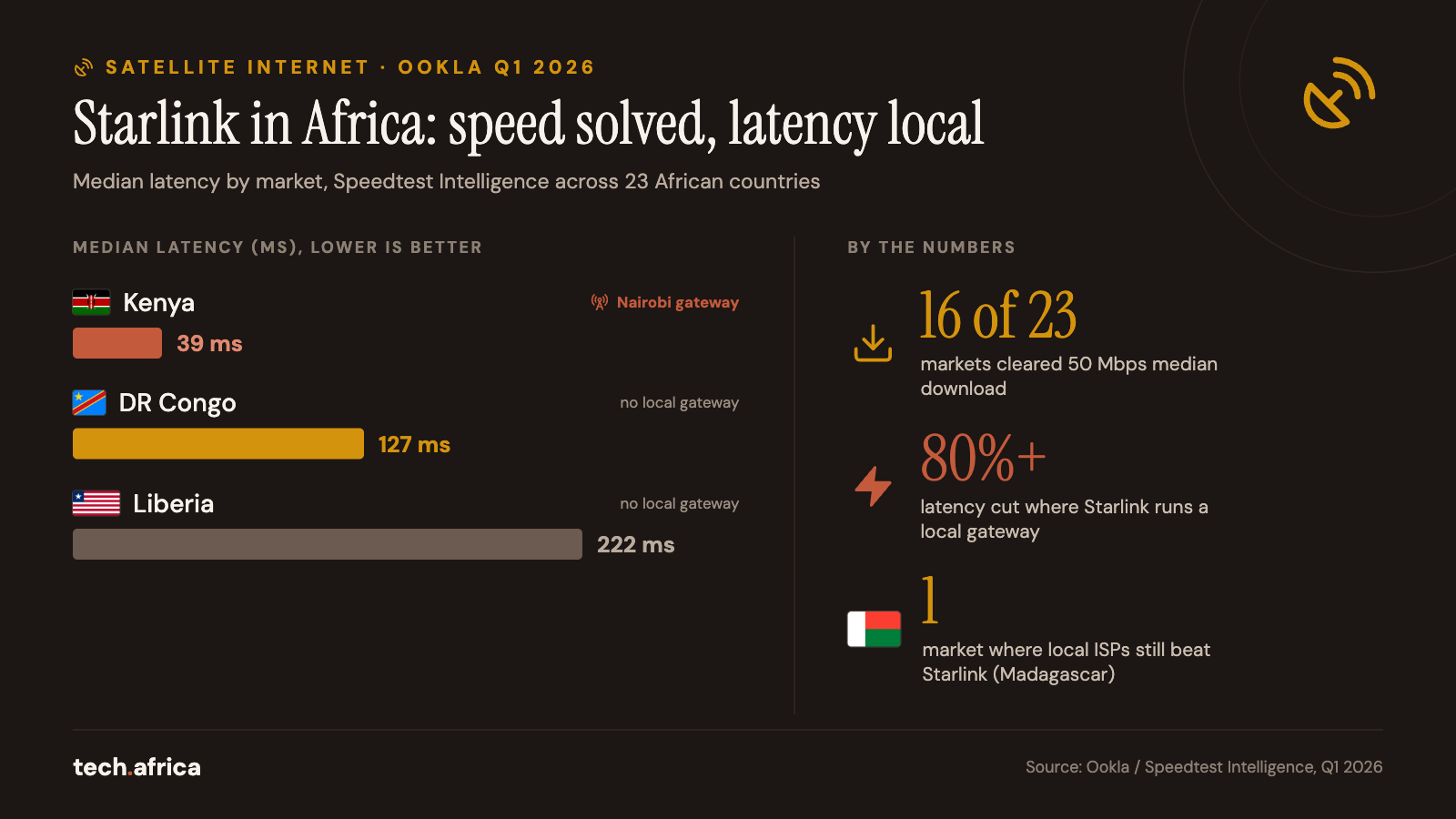
Independent measurement tells a similar story. Ookla’s Speedtest Intelligence found Starlink beating local internet providers in almost every African market in early 2026, with 16 of 23 measured countries clearing 50 Mbps. The catch is routing: where traffic passes through a nearby Starlink gateway, latency drops sharply; where it does not, it climbs.
In practice those medians comfortably support video calls, 4K streaming and online gaming, the kind of use that strained older satellite services. Upload speeds are lower, typically 17 to 42 Mbps, but still ahead of much of the fixed-line competition in these markets.
The gateways behind the speeds
Starlink’s African performance is anchored by a small number of ground gateways. Public network records from PeeringDB show the company connected in three African cities, peering at the local internet exchanges:
- Johannesburg, South Africa: colocated at the Teraco campus, peering at the NAPAfrica and JINX exchanges.
- Lagos, Nigeria: at Equinix’s Lekki data centre, peering at IXPN Lagos, its largest African connection at 600 Gbps, and AMS-IX Lagos.
- Nairobi, Kenya: at the icolo.io facility, peering at KIXP and LINX Nairobi.
These gateways are why Kenya records some of the continent’s lowest latency, and why countries far from one see higher delays. There is also an irony buried in the list: Starlink’s biggest African gateway sits in Johannesburg, yet South Africans cannot legally buy the service.
What the African Starlink market tells us
The monthly price is uniform; the kit is the barrier
Across the live markets the monthly cost is strikingly consistent: roughly $30 to $60 in dollar terms for the standard Residential plan, with the cheapest options in the markets Starlink prices directly in US dollars and the Residential Lite tier dropping as low as $30. Nigeria, at about $37 a month, is among the most affordable.
The real barrier is the hardware. The Standard kit lands at roughly $380 to $390 and the Mini around $200, a one-off cost that equals several months of average income in lower-income markets such as Chad or DR Congo, and a meaningful chunk even in Nigeria or Kenya. For many households the dish, not the subscription, decides whether Starlink is within reach.
Where Starlink matters most
Starlink’s value is highest where the ground is hardest to wire. Several of its live markets are large, sparsely populated and barely served by fixed broadband: Chad, at around 13 people per square kilometre, the Central African Republic at about 8, Niger and DR Congo are exactly the places where laying fibre to every town is uneconomic. Across much of this territory Starlink is not competing with terrestrial internet; it is the first reliable high-speed option to arrive.
The picture flips in dense, better-connected markets. Rwanda, one of Africa’s most crowded countries at over 500 people per square kilometre, and the cities of Nigeria and Kenya already have fibre and mobile data, so Starlink there is a premium or backup choice rather than a lifeline.
It fills the gap that 5G does not reach
Africa’s 5G build-out, though real, is overwhelmingly urban. By the end of 2025 some 53 operators across 29 African countries had launched 5G, but coverage clusters in capitals and big cities; Nigeria, an early mover since 2022, still had a 5G coverage gap of more than half the country. GSMA Intelligence expects 5G to reach only around 17% of connections by 2030, led by South Africa, Nigeria and Kenya.
That leaves a vast rural middle where neither 5G nor fibre reaches and where mobile data is slow and capped. This is Starlink’s core African market: not the cities, where it overlaps with fast terrestrial networks, but the towns and farms beyond them.
South Africa: the big exception
South Africa is the continent’s largest internet economy and one of the most vocal Starlink markets, yet the service is unavailable there. The block is regulatory, not technical.
To hold a telecoms licence in South Africa, a company must be at least 30% owned by historically disadvantaged South Africans under the country’s Broad-Based Black Economic Empowerment (B-BBEE) rules. SpaceX has resisted ceding equity, and the licence has stalled.
A path is opening. In December 2025 the government introduced an Equity Equivalent Investment Programme (EEIP) framework, which lets multinationals meet the empowerment requirement through local investment in skills, suppliers, jobs and infrastructure rather than handing over shares. SpaceX has said it intends to comply and has pledged R2.5 billion of investment, and Starlink has run a campaign urging South Africans to lobby the regulator.
The timeline remains uncertain. The regulatory process could take 12 to 18 months, pointing to a possible launch in late 2026 or 2027, and Starlink’s own availability page still lists South Africa’s service date as unknown. Our earlier analysis, Starlink in South Africa: hype or hope?, set out the stakes, and the ICASA satellite spectrum review now under way is one of the levers that could shift it.
The other markets holding out
South Africa is the most prominent holdout, but it is not alone, and the reasons fall into two broad camps: protecting incumbent or state-owned telecoms, and guarding security and sovereignty.
Ethiopia has kept low-Earth-orbit providers out almost entirely. Its regulator has said it held no licensing talks with Starlink at all, and the state has opened its long-closed telecoms market only cautiously, to a single Safaricom-led consortium.
Morocco sits in regulatory limbo: Starlink has reportedly set up a local entity, but the regulator has yet to issue a licence amid resistance from established operators who see it as a disruptive rival. Egypt goes further, with the service effectively blocked and users told it is not enabled in the country, a stance tied to its tightly controlled telecoms sector and security concerns.
Cameroon banned Starlink in 2024 on data-sovereignty and competition grounds, and customs has seized imported kits, though officials signalled in late 2025 that a concession agreement may be moving forward. In conflict-affected Sudan the service is unlicensed and used mostly on the black market, while Algeria, Libya, Djibouti and Eritrea sit in a quieter limbo with no committed date.
Tanzania is further along: Starlink has applied for a licence and the market is partly served through an Airtel Africa direct-to-device arrangement, even as the full residential service waits on approval.
How to choose, and what you need
If Starlink is live in your country, the main decisions are hardware and tier:
- Standard kit or Mini: the Standard kit is the full home dish with a Wi-Fi 6 router; the Mini is smaller, portable and cheaper, suited to travel or a single-room setup.
- Residential or Residential Lite: Residential is the full-priority home plan with unlimited data; Lite is cheaper but slows first when the network is busy. Where offered, a capped 250GB plan is cheaper still.
- Setup: Starlink is built for self-installation and works within minutes of plugging in, with no contract in most markets.
Ordering is straightforward where the service is live: check availability for your address on Starlink’s site, choose the kit and plan, pay for the hardware plus the first month, and set the dish up yourself with a clear view of the sky.
Whether it is worth it depends on what you are replacing. The kit is a real upfront cost, from around $200 for a Mini to the equivalent of several hundred dollars for the Standard dish, which is steep against local incomes. But for homes and businesses beyond fibre or reliable mobile coverage, Starlink usually delivers far faster speeds and lower latency than the alternatives, with unlimited data on the Residential plan. In cities already wired for fibre, it is rarely the cheapest option.
For anywhere not yet on Starlink’s map, or if you are in South Africa, see our guide to Starlink competitors and alternatives, several of which already serve African markets.
Starlink’s African footprint is expanding fast, but unevenly, shaped as much by regulators as by rockets. Availability, prices and the coming-soon list all change frequently, and we will keep this guide updated.


Leave a Reply