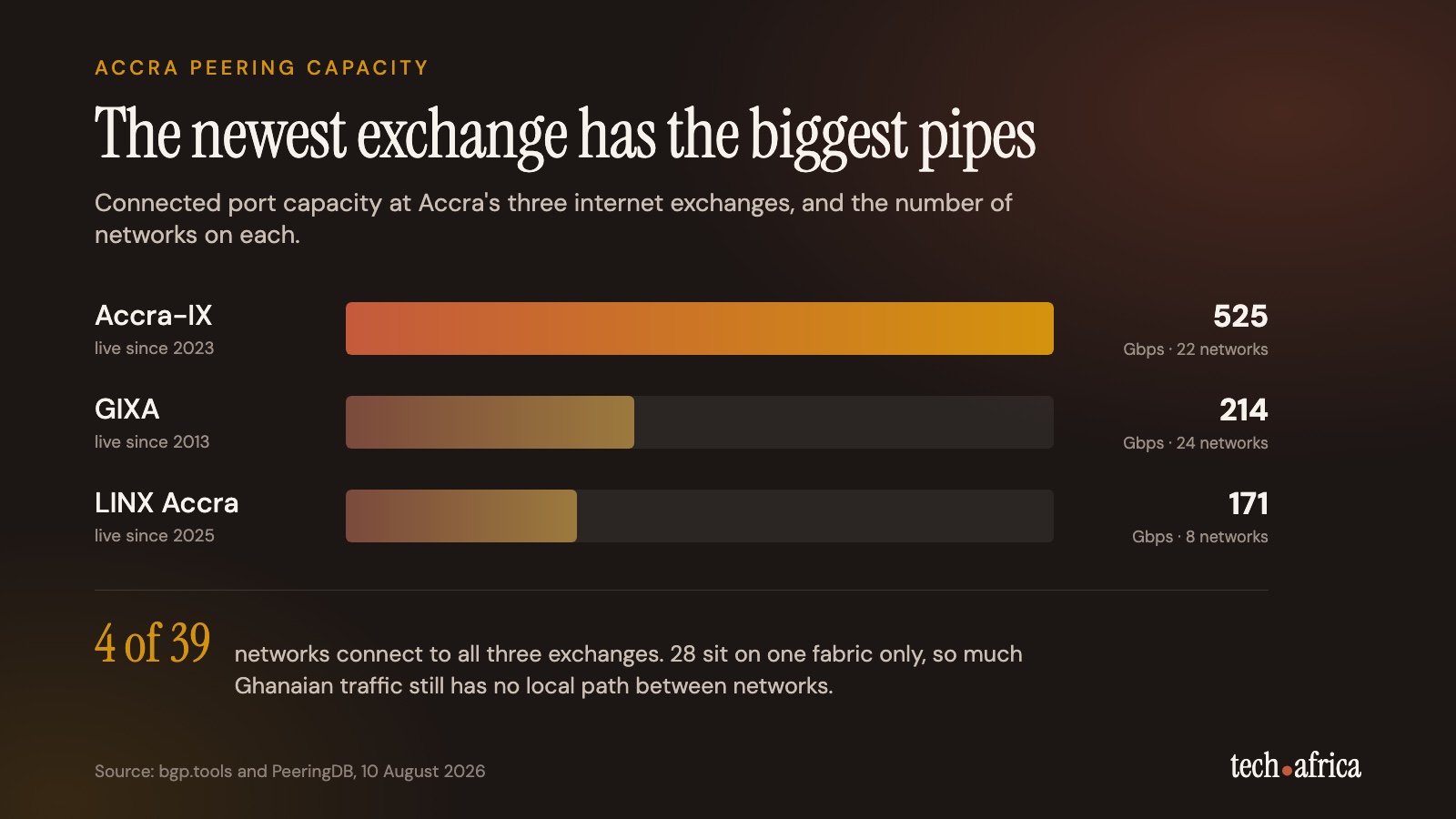
Ghanaian internet exchange Accra-IX says it has passed 200 Gbps of aggregate traffic. Its members have 525 Gbps of ports plugged into the exchange, so the figure is entirely consistent with the fabric it runs.
The more revealing number is four. That is how many networks connect to all three of the internet exchanges in Accra, Ghana, the shared switches where networks hand traffic straight to each other instead of paying a transit provider to carry it.
Key takeaways
- Accra-IX reports 200 Gbps of aggregate traffic against 525 Gbps of connected port capacity, roughly 38% utilisation.
- It has fewer members than GIXA, 22 against 24, but about two and a half times the capacity.
- Accra has three exchanges. Across them, 39 distinct networks sit: only 4 on all three, and 28 on just one.
- Google and Akamai peer at GIXA alone. Fastly is at Accra-IX alone. Meta is the only content network on all three.
- For scale, NAPAfrica in Johannesburg, South Africa passed 5 Tbps in 2025.
The milestone, in proportion
Accra-IX went live in 2023, and tech.africa covered its launch as the newest exchange on the continent at the time. Passing 200 Gbps inside three years is real growth for a young fabric.
The exchange publishes no publicly readable traffic graph, so the figure announced on 10 August 2026 is the operator’s own. It is not, however, an implausible one.
Public routing data shows four 100 Gbps ports on the exchange, belonging to Meta, Fastly, Scancom, which trades as MTN Ghana, and GVA of Cote d’Ivoire, alongside a spread of 10 Gbps connections. Against 525 Gbps of provisioned capacity, 200 Gbps of traffic is ordinary utilisation rather than a stretch.
Scale is the caveat that matters more. NAPAfrica passed 5 Tbps in 2025, and IXPN in Lagos, Nigeria moved to 400G ports this year. Ghana’s local traffic is growing from a low base.
Three exchanges, three different shapes
GIXA, the Ghana Internet Exchange Association, has run since 2013. Accra-IX followed in 2023. LINX, the London exchange, opened an Accra fabric and registered it in mid-2025.
They are not simply larger and smaller versions of each other. GIXA carries 24 networks across 27 routers, but its biggest ports are 20 Gbps, held by MTN Ghana, Telecel, and Google, for a total of about 214 Gbps.
Accra-IX carries traffic from 22 networks across 22 routers, totalling 525 Gbps. LINX Accra has 8 networks and 171 Gbps, most of it a single 100 Gbps Meta port.
So the older exchange has the wider membership, and the newer one has the capacity. Ghana’s peering has been split by role rather than consolidating.
Where the content sits
That split runs through the networks people actually consume. Google and Akamai connect at GIXA and nowhere else in Accra, while Fastly connects at Accra-IX and nowhere else.
Meta is the exception, present on all three, and on 100 Gbps ports at both Accra-IX and LINX.
A retail internet provider connected only to Accra-IX therefore has no local path to Google or Akamai, two of the heaviest sources of traffic on any consumer network, and must buy transit to reach them. That is the expense local peering exists to remove.
GIXA also hosts the measurement infrastructure. Packet Clearing House and the University of Oregon’s Route Views project both connect there, as does Ghana’s academic and research network. MainOne, whose parent Equinix has been building a second Nigerian gateway, peers at GIXA rather than Accra-IX.
Among the mobile operators the split runs the other way. MTN Ghana connects to both, at 20 Gbps on GIXA and 100 Gbps on Accra-IX. Airtel Ghana appears at GIXA alone.
Four networks out of 39
Counting across all three exchanges gives 39 distinct networks in Accra. Only 4 are on all three: Meta, AFR-IX Telecom, Broadspectrum and The Cloud Network. A further 28 are on one exchange only.
That is the practical cost of fragmentation. Two Ghanaian networks that each believe they are peering locally may share no fabric at all, in which case traffic between them travels via transit, quite possibly leaving the country and returning.
How these figures were compiled
Membership and port speeds were taken from bgp.tools on 10 August 2026 and cross-checked against PeeringDB the same day. The two agree exactly on the shape of the overlap: 39 networks, 4 on all three exchanges, 28 on one.
Operator pages differ slightly, as they usually do. GIXA lists 23 connected networks on its own site, and Accra-IX lists 26, compared with 24 and 22 in the routing databases. Network names come from registry records rather than from the exchanges’ own descriptions.
One caveat stands. A connected port is not traffic. These figures show what is plugged in and how fast it could run, not what is flowing through it, which is precisely the gap a public traffic graph would close.
The question worth asking
Three exchanges in one city is not self-evidently wrong. Competition brought Ghana a 100 Gbps-capable fabric within three years of Accra-IX opening, and LINX’s arrival followed the larger exchanges’ move into Africa.
But an exchange is worth what it connects you to, and with 28 of 39 networks on a single fabric, Ghana has three partial views of its own internet rather than one complete one.
The measure that would settle whether local peering is genuinely growing is not any single exchange’s aggregate. It is how much Ghanaian traffic stays in Ghana, and that is the one figure none of the three currently publishes.




Leave a Reply