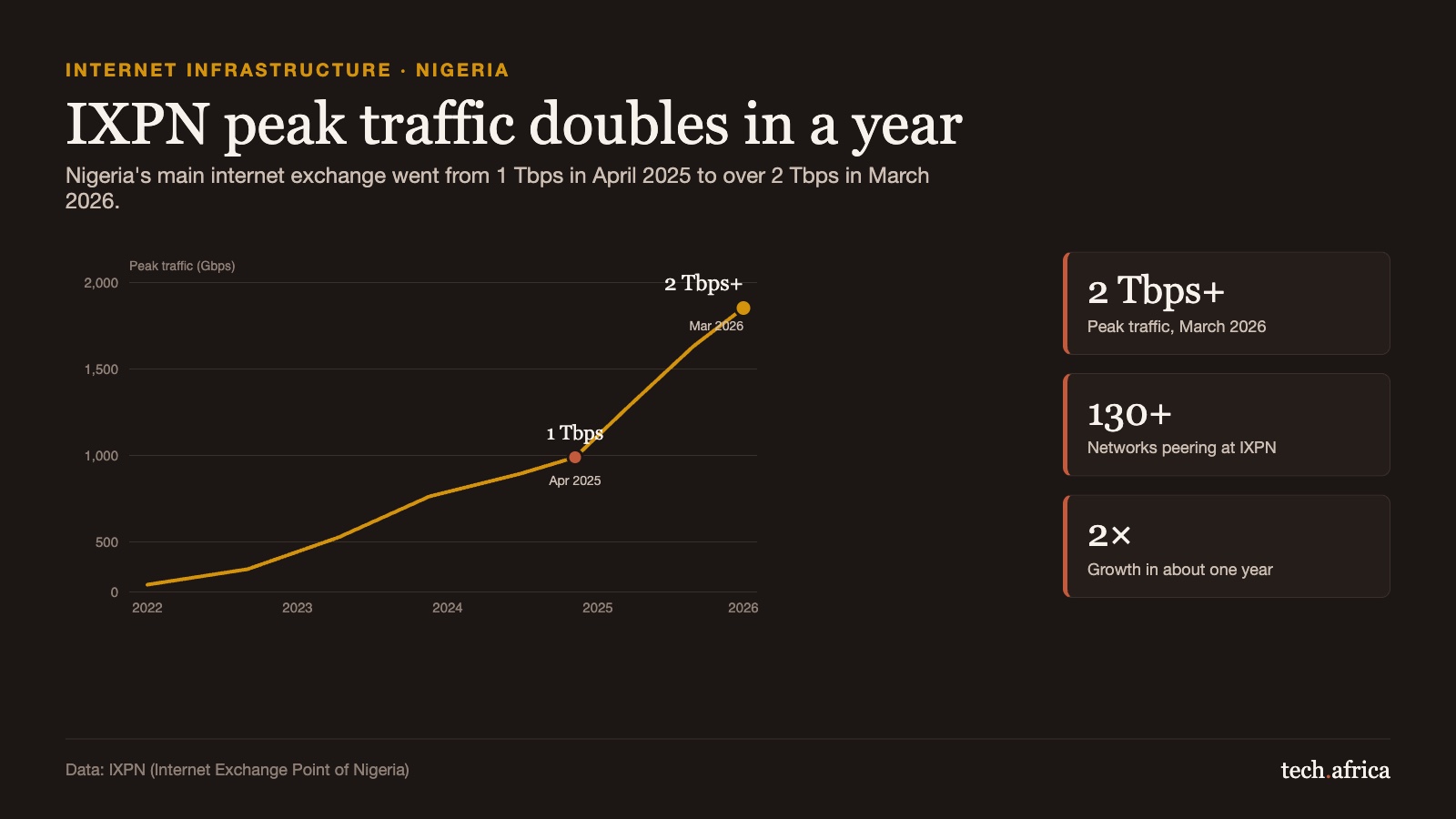
Nigeria’s main internet exchange now carries more than 2 terabits per second of traffic at peak, double what it handled a year ago, and the surge is being driven by the world’s biggest content networks moving closer to Nigerian users.
The Internet Exchange Point of Nigeria (IXPN) said its peak traffic crossed 2 Tbps in March 2026, up from about 1 Tbps in April 2025, with more than 130 networks connected across several data centres.
Hyperscalers are the engine
Independent routing data compiled by bgp.tools lists 129 networks across 158 routers connected to IXPN’s main Lagos fabric, a figure that aligns with the exchange’s own count of more than 130. They include Google, with its dedicated Global Cache, alongside Meta, Microsoft, Cloudflare, Amazon and Akamai.
Those names matter more than the raw count. When a hyperscaler installs a cache at the exchange, requests for its content, from video streams to app updates and social feeds, are answered from Lagos rather than from Europe or North America. That both reflects and feeds the traffic growth: more local content gives networks more reason to peer, and more peers pull in more content.
Nigeria’s own operators sit on the same fabric, among them MTN Nigeria, Airtel, Globacom, ipNX, Spectranet and MainOne, so traffic between local providers and global platforms increasingly stays inside the country.
What an internet exchange does
An internet exchange point (IXP) is a shared infrastructure where networks exchange traffic directly rather than routing it through third parties abroad. Keeping that exchange local shortens the distance data has to travel, which IXPN says gives members lower latency, lower transit costs, stronger resilience and faster content delivery.
A year of doubling
IXPN passed the 1 Tbps mark in April 2025. Crossing 2 Tbps eleven months later tracks both rising data demand in Nigeria and the steady expansion of content caches at the exchange.
By keeping a larger share of traffic local, the exchange reduces the amount of Nigerian internet data that has to leave the country and return, a pattern that historically has added cost and delay.
Part of a wider African shift
Nigeria’s growth mirrors a broader continental push to keep traffic local. South Africa’s NAPAfrica is Africa’s largest internet exchange by traffic, and several markets have expanded peering and local caching as more operators and content networks plug in.
With peak traffic doubling inside a year and the major content networks already on-net, IXPN’s trajectory suggests Nigeria is steadily building the local interconnection it needs to keep its own internet traffic at home.

Leave a Reply