
Sub-Saharan Africa is set to become the fastest-growing 5G market on the planet, with subscriptions forecast to multiply more than tenfold by 2031.
That is the headline projection from the June 2026 edition of the Ericsson Mobility Report, published by Swedish telecommunications equipment maker Ericsson. It estimates that 5G subscriptions in the region will rise from around 30 million in 2025 to roughly 370 million by 2031, the steepest growth rate of any region worldwide.
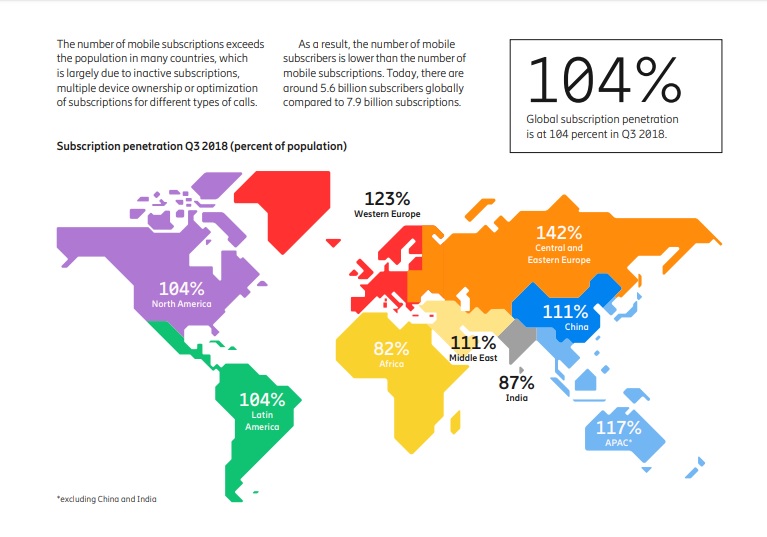
The forecast lands as global 5G subscriptions passed the three billion mark in the first quarter of 2026. Sub-Saharan Africa is starting from a far smaller base, but its trajectory is now the sharpest anywhere. Mobile technology already contributes hundreds of billions of dollars to the continent’s economy each year.
From 2G to 5G
Total mobile subscriptions across Sub-Saharan Africa are expected to reach 1.31 billion by 2031, up from 1.05 billion in 2025.
The bigger shift is in the mix. Ageing 2G and 3G networks are forecast to shrink sharply as 4G and 5G take over. LTE (4G) subscriptions are projected to grow from 490 million in 2025 to 610 million by 2031, accounting for 46% of all connections, while 5G reaches 28% by the end of the period.
Commercial 5G remains patchy across the region, but rollouts are spreading, from Paratus launching an LTE and 5G network in Namibia to expansions by the larger mobile operators.
Data demand climbs
Average monthly mobile data use per active smartphone in the region is forecast to more than double, from 5.3 GB in 2025 to 12 GB in 2031.
Total mobile data traffic across Sub-Saharan Africa is set to rise from 2.8 exabytes per month in 2025 to 9.7 exabytes per month by 2031, as more users move onto faster networks and heavier applications.
Majda Lahlou Kassi, vice-president and head of Ericsson West and Southern Africa, framed the transition as a chance for the region to skip a technology generation.
The acceleration of 4G and 5G is a defining opportunity for Africa to leapfrog into the AI era. By transitioning away from legacy networks, we are building the foundation for a vibrant, inclusive digital economy.
Majda Lahlou Kassi, vice-president and head of Ericsson West and Southern Africa
Lahlou Kassi added that the right investments in spectrum and policy frameworks would let the region “fully participate in, and benefit from, the AI boom”.
Fixed wireless and the uplink shift
Beyond mobile handsets, the report flags Fixed Wireless Access (FWA), home and business broadband delivered over a mobile network rather than a cable, as a growing priority for operators trying to close the region’s stubborn broadband gap.
It also notes a broader global pattern now reaching Africa: uplink traffic, the data users send rather than receive, is growing faster than downlink for most operators. The drivers are video calls, the sharing of user-generated content, cloud storage and a new wave of AI applications. African operators are already wiring AI into their networks, as MTN did when it joined NVIDIA, Cisco and Nokia in a $45 million AI-RAN venture.
Whether the forecast holds will depend on spectrum allocation, device affordability and sustained network investment, all of which have slowed past technology transitions on the continent. The direction, though, is clear: Sub-Saharan Africa’s networks are being rebuilt for data, and increasingly for AI.


Leave a Reply