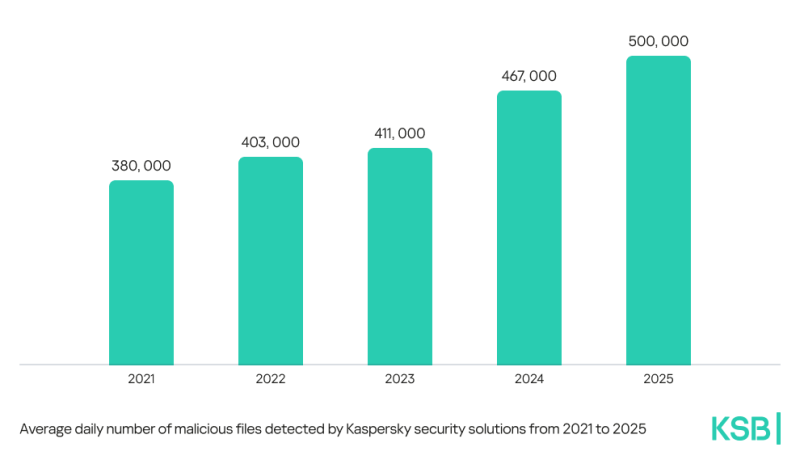
Cybersecurity company Kaspersky has reported detecting an average of 500,000 malicious files each day during 2025, a 7% increase on the previous year.
The figures, covering the period from November 2024 to October 2025, come from the company’s Security Network and form part of its annual Kaspersky Security Bulletin.
Certain threat categories showed robust growth: detections of password stealers rose by 59%, spyware by 51%, and backdoors by 6% compared with 2024.
Windows users remained the primary target, with 48% encountering some form of threat during the year, while the figure for Mac users was 29%.
Globally, 27% of users faced web-based threats, which involve malware distributed or activated via the internet. The highest rates were in Latin America (26%) and Africa (25%).
On-device threats, often spread through removable drives or hidden in installers and encrypted files, affected 33% of users worldwide. Africa recorded the highest proportion at 41%, followed by Asia-Pacific (33%), the Middle East (32%), Latin America (30%), and Europe (20%).
Alexander Liskin, head of threat research at Kaspersky, highlighted the growing sophistication of attacks, including the resurgence of commercial spyware, increased exploitation of vulnerabilities, and a rise in supply-chain incidents.
He stressed the importance of robust cybersecurity measures for both individuals and organisations to counter these evolving risks.



Leave a Reply