HTML is the acronym for HyperText Markup Language. In essence, it is the language in which web pages are written and interpreted by web browsers. HTML5 is thus the latest version of HTML. According to Wikipedia:

HTML5 is currently being developed as the next major revision of HTML (HyperText Markup Language), the core markup language of the World Wide Web. HTML5 is the proposed next standard for HTML 4.01, XHTML 1.0 and DOM Level 2 HTML. It aims to reduce the need for proprietary plug-in-based rich internet application (RIA) technologies such as Adobe Flash and Microsoft Silverlight. In common usage, HTML5 may also refer to the additional use of CSS3, as both technologies are under development in parallel.
Another definition of HTML5 from html5.org is as follows:
HTML5 is a new version of HTML and XHTML. The HTML5 draft specification defines a single language that can be written in HTML and XML. It attempts to solve issues found in previous iterations of HTML and addresses the needs of Web Applications, an area previously not adequately covered by HTML.
As the world wide web gears up for the full unleashing of HTML5, some web browsers are already supporting some elements of HTML5. The support varies widely. A relatively new web tool attempts to reveal the HTML5-compatibility of your web browser. All you need to do is visit http://html5test.com and within some seconds, the full report would be revealed.
I have tried it from four different browsers, with interesting results. The following list is based on the performance of the web browsers:
| Browser | SCORE out of 160 | Great | Good | Reasonable | Badly | Non-existent |
| Google Chrome 5.0.375.55 | 142 | Doctype, Canvas, Video, Geolocation, Storage, Offline web apps, Workers, Section elements, Grouping content elements | Audio, Text-level semantic element, forms | User interaction | ||
| Apple Safari 4.0.5 | 115 | Doctype, Canvas, Storage, Offline web apps, Workers, Section elements, Grouping content elements | Video, Audio, Grouping content elements, Text-level semantic element | Forms, User interaction | ||
| Opera 10.53 | 102 | Doctype, Canvas, Audio, Storage | Video | Offline web applications, Forms, User interaction | Geolocation, Workers, Section elements, Grouping content elements, Text-level semantic element | |
| Mozilla Firefox 3.6.3 | 101 | Doctype, Canvas, Geolocation, Storage, Workers | Video, Audio | Offline web applications, User interaction | Forms | Section elements, Grouping content elements, Text-level semantic elements |
| Internet Explorer 8.0.7600 | 19 | Doctype, Storage | User interaction | Canvas, Video, Audio, Geolocation, Offline Web Applications, Workers, Section elements, Grouping content elements, Text-level semantic element, Forms |
From the above table, it is clear that using HTML5-compatible as the yard-stick, Google Chrome is currently the most progressive web browser today while Internet Explorer is the worst. This doesn’t come as a surprise to me. Rather, I am somewhat disappointed that Mozilla Firefox is towards the end of the table. Note that beta versions of the listed web browsers might necessarily support more HTML5 attributes.
As of April 2010, Internet Explorer is still the market leader in the browser arena those the coverage of the browser has shrinked drastically, over the past few years. See below:
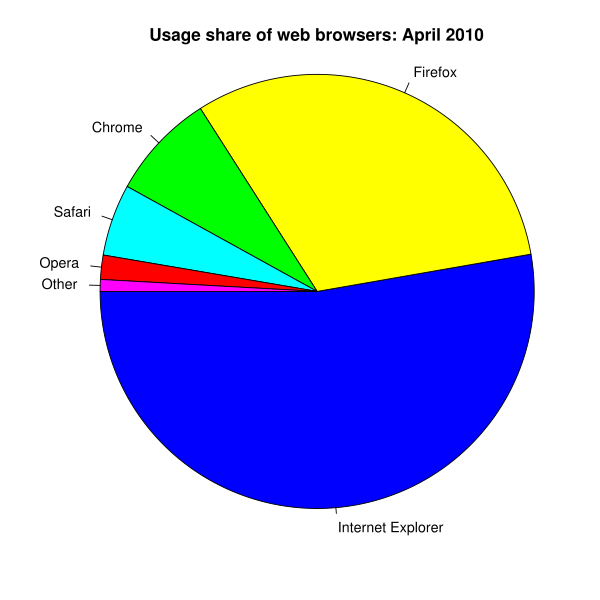
Web browser usage
Internet Explorer (53.26%; Usage by version number)
Mozilla Firefox (31.60%; Usage by version number)
Google Chrome (8.00%)
Safari (5.40%)
Opera (1.82%)
Other (0.89%)



Leave a Reply